Thimonnier Stitcher
1830 · Chain Stitch Sewing Machine · Work 308 of 1,871
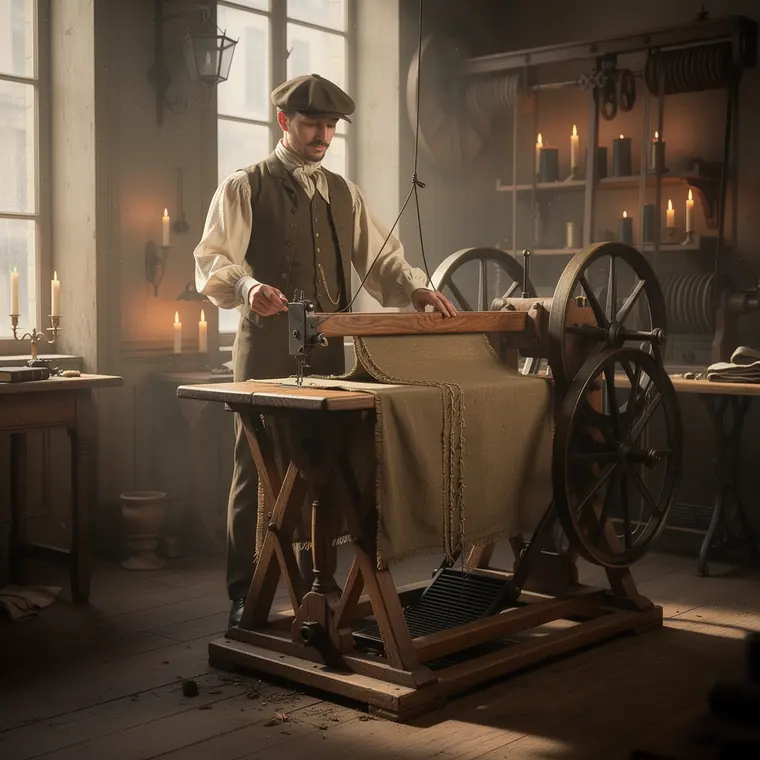
Barthelemy Thimonnier's sewing machine in a Paris uniform workshop, a machine built of wood, a wooden frame and arm carrying a hooked barbed needle that passes down through the cloth and pulls the thread up into a loop, driven by foot treadle and overhead cord, chain stitching army cloth, the operator in a linen shirt, waistcoat, neckcloth and cloth cap of a working tailor, the room lit by daylight from tall windows and by candles.
- What it was used for
- Barthélemy Thimonnier, a tailor from Amplepuis, patented a wooden sewing machine in 1830. The Science Museum records that by 1830 Thimonnier had 80 machines at work in a Paris workshop making army clothing; Encyclopaedia Universalis and Britannica give the same figure and the same purpose. The Musée des arts et métiers calls the workshop the first for mechanised garment making. Wages, the number of uniforms produced and the price of a machine are not documented. In 1831 a crowd of tailors wrecked the workshop; Britannica speaks of some 200 rioters who feared for their trade. The machine was destroyed by the very trade whose product it sewed; Thimonnier died in poverty in 1857.
- What was new
- The machine made the chain stitch of tambour embroidery by machine: a barbed needle drew thread from a reel below the table up through the cloth and formed the loop on the upper surface, continuously, where the work had been done by hand before. It used a single thread, and that was its limit, because a single-thread chain stitch can unravel; Elias Howe's lock stitch of 1846 uses two. Who was first depends on which wording one takes: the Science Museum says carefully that Thimonnier was the first to achieve any practical success, which is precisely not a claim to first invention, while other museums list him outright as the builder of the first workable sewing machine.
Further reading
- Science Museum Group Collection: Copy of Thimonnier's chain-stitch sewing machine, 1830
- Musée des arts et métiers: Modèle, première machine à coudre de Thimonnier
- Encyclopaedia Britannica: Barthélemy Thimonnier
- British Library: Sewing machines, who really invented them?
- Museum of American Heritage: History of the Sewing Machine
- Encyclopaedia Universalis: Machine à coudre de Thimonnier