Bell Roller Printer
1783 · Roller Printing Machine · Work 311 of 1,871
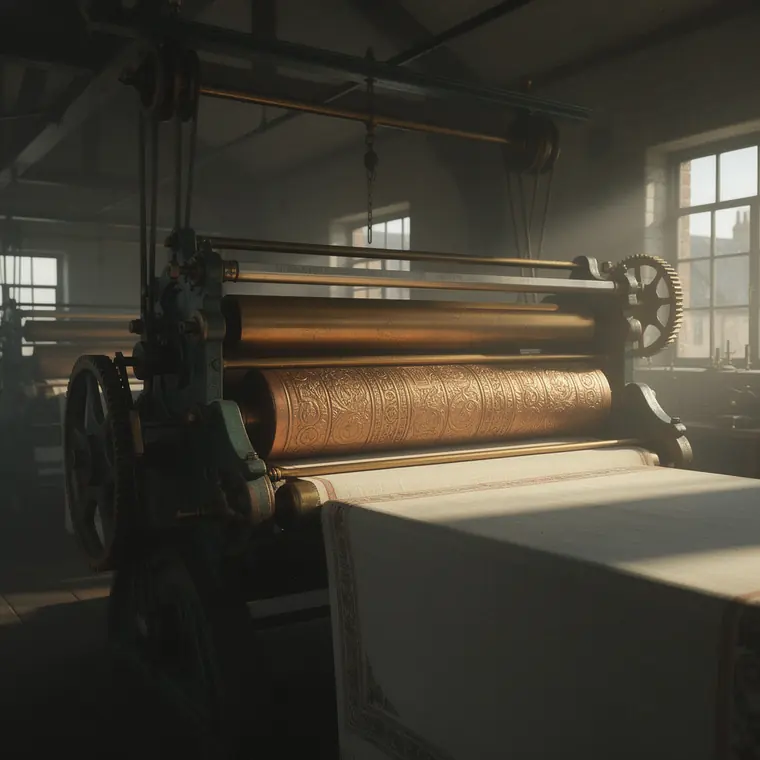
Thomas Bell's roller printing machine in a Lancashire print works, engraved copper cylinders pressed against a central drum with doctor blades scraping paste as calico runs through.
- What it was used for
- Thomas Bell, listed in the official patent index as a callico printer of Mosney in the county of Lancaster, was granted patent no. 1378 on 17 July 1783 for a method of printing with one colour, or with various colours at the same time, on linens, cottons, calicoes, woollen cloth and silks. Edward Baines wrote in 1835 that it was first successfully applied about the year 1785 at Mosney near Preston by the house of Livesey, Hargreaves, Hall and Co. Baines reckons that one cylinder machine, attended by a man and a boy, did as much work as a hundred block printers and as many tear-boys, and that by 1835 three quarters of all British printing was done on it. The house that made the machine work collapsed in 1788; Baines calls the magnitude of that failure a severe shock to the industry of that part of the country.
- What was new
- A block printer set a sycamore block of about ten by five inches with one colour per impression; for a piece of 28 yards that came to 448 impressions by Baines's count, while the engraved copper cylinder printed the same piece in one or two minutes and laid on up to five colours in a single pass. What made it work was an elastic steel blade, the doctor, which took the colour off the roller outside the engraving without scratching the copper. Who had the roller first cannot be decided from the patent titles: Bell's title of 1783 mentions no roller at all, a machine printing patent already existed in 1772 as no. 1007 to Adkin and others, and John Slater, also of Mosney, obtained patent no. 1433 on 29 April 1784. In France the house of Oberkampf was held to be the originator; the article in Ure's Dictionary of 1875, contributed by James Higgin of Manchester, holds that the honour is due to Great Britain.
Further reading
- Great Britain Patent Office / B. Woodcroft, Titles of Patents of Invention, Chronologically Arranged, 1617-1852, Part I
- Edward Baines, History of the Cotton Manufacture in Great Britain, London 1835, S. 264-266
- Ure / Hunt / Rudler, A Dictionary of Arts, Manufactures and Mines, 7. Aufl., London 1875, Art. Calico-printing
- Grace's Guide: Livesey, Hargreaves, Hall and Co