Tennant Bleach Works
1799 · Chloride of Lime Bleaching · Work 312 of 1,871
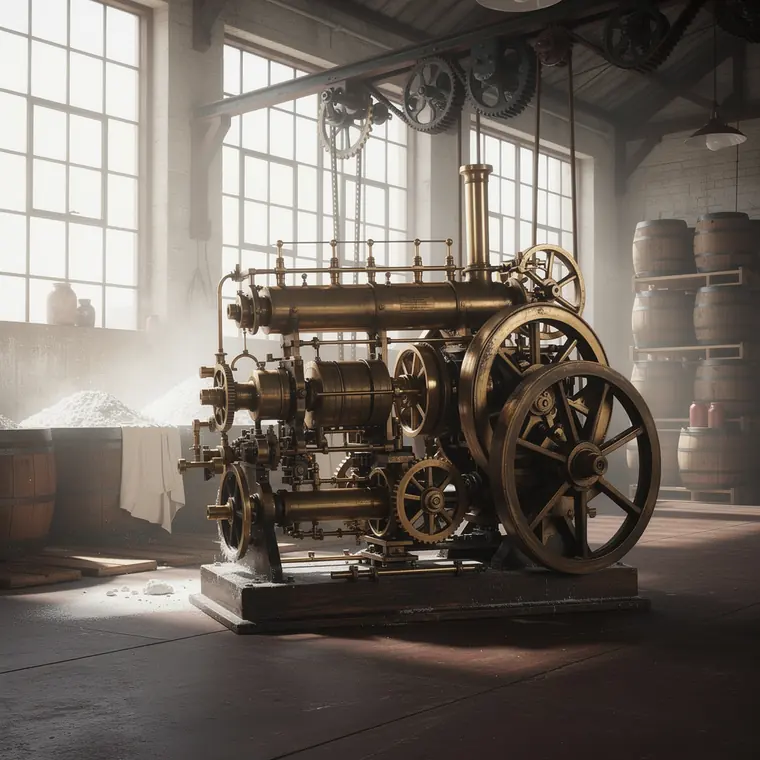
Charles Tennant's bleaching powder works at St Rollox, chambers of slaked lime taking up chlorine, casks filled beside vats where cloth soaks instead of lying on grass crofts.
- What it was used for
- Charles Tennant, listed in the patent index as a bleacher at Darnley near Glasgow, made bleaching powder at the St Rollox works, for bleachfields and calico printers. John R. R. Christie puts output at 50 tons in the first year and close to 10,000 tons by about 1870, and the workforce at at least 500 in the 1830s and at least 1,500 in the 1860s. Baines in 1835 gives as an unremarkable performance that a Lancashire bleacher took in 1,400 pieces of grey muslin on a Tuesday and returned them bleached, sixteen miles away, on the Thursday following. What stayed behind was the tip: according to the Hunterian, every ton of soda left about two tons of residue, over a century more than a hundred acres of it and up to 24 metres deep. On the figures of the contractor for the since completed Sighthill remediation, the works left nearly a million cubic metres of that material.
- What was new
- Grass bleaching took six to eight months by Baines's account: steeping in alkaline lye and weeks of crofting on the field, alternately five or six times, then steeping in sour milk. Berthollet's chlorine, known from 1785 and brought to Glasgow by Watt in 1786, cut that from months to days or even hours, but it was caustic and as a liquid it stored and shipped badly; Tennant's patent no. 2312, granted 30 April 1799, describes the oxygenated muriates in a dry, undissolved or powdery form, and that turned the bleach into a commodity. Who invented the dry process is disputed: the Biographical Memoir of the Late Charles Macintosh, Glasgow 1847, reports that Macintosh claimed he, and not Tennant, was the inventor. The earlier liquor patent of 1798 fell in 1802, because the use of lime in bleaching before the patent date could be proved.
Further reading
- Great Britain Patent Office / B. Woodcroft, Titles of Patents of Invention, Chronologically Arranged, 1617-1852, Part I (Nr. 2209 und Nr. 2312)
- Edward Baines, History of the Cotton Manufacture in Great Britain, London 1835, S. 246-251
- J. R. R. Christie, Chemistry through the Two Revolutions: Chemical Glasgow and its Chemical Entrepreneurs 1760-1860, MPIWG Preprint 472, 2015
- Biographical Memoir of the Late Charles Macintosh, F.R.S., Glasgow 1847
- The Hunterian, University of Glasgow: St Rollox, Residues of Glasgow's Industrial Past
- VHE Construction: Sighthill Transformational Regeneration Area (Projektseite)