Perrotine
1834 · Perrotine Block Printing · Work 313 of 1,871
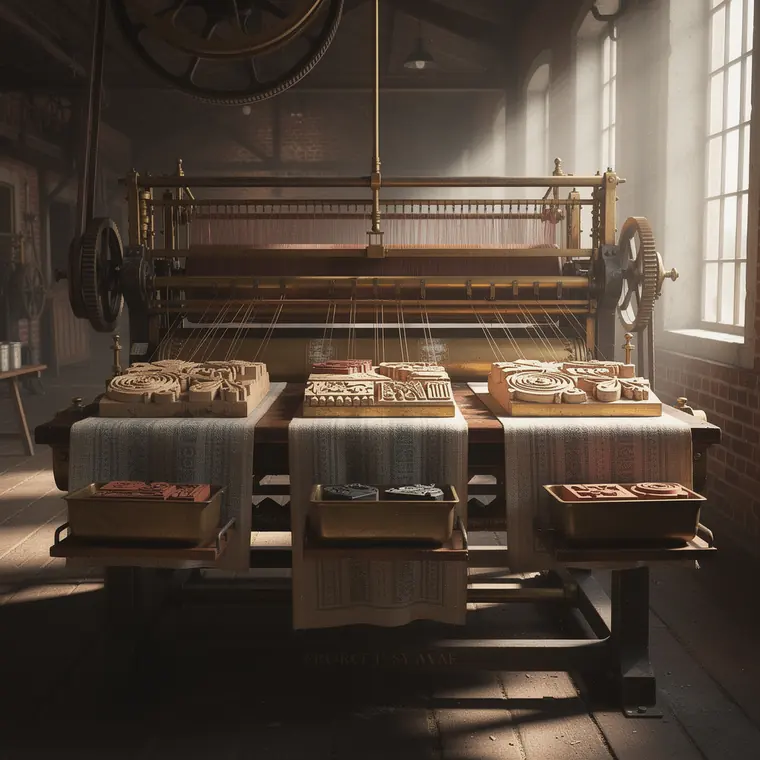
Louis-Jerome Perrot's perrotine block printing machine in a Rouen print house, three carved blocks striking the cloth table from three sides in turn, paste boxes feeding each.
- What it was used for
- From Rouen, Louis-Jérôme Perrot introduced a machine into the French print works in 1834 that mechanised block printing: three wooden blocks stand at right angles on a cast iron frame and press in turn against a revolving prism carrying the cloth. It was worked by one man with one or two children, and it printed three colours. On output the sources differ: Ure gives about thirty English pieces a day, the American Cyclopaedia, for the machine as improved in 1844, one thousand to fifteen hundred yards a day for two men. the Manchester Guardian, quoted by Grace's Guide, reported some 250 perrotines at work on the Continent in 1839, by Ure's account chiefly in France and Belgium; it reached Britain in 1837 through the Manchester firm of Joseph and John Lockett and found little favour there.
- What was new
- Roller printing after Bell printed fast but did not saturate the cloth with colour as a block did; the perrotine carried the block printer's solid colour onto a machine and thereby replaced, by Ure and Hunt's reckoning, the work of about twenty hand printers. The calculation has a reverse side stated in the source itself: what it replaced was twenty men and twenty children, and one or two children went on working at the machine. Child labour did not vanish, it was concentrated. On its lower output against the roller machine it foundered; in the second half of the century it virtually disappeared. No number for the French patent of 1834 could be documented.