Perkin Dye Works
1856 · Aniline Dye Works · Work 314 of 1,871
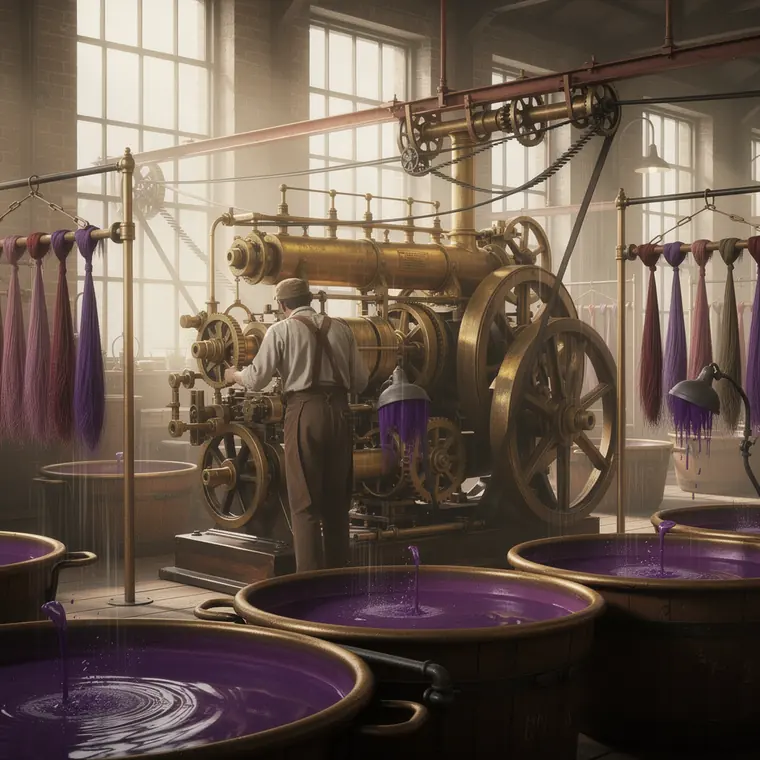
William Perkin's aniline dye works beside the canal at Greenford Green, stirred vats of dye liquor with skeins of silk lifted on poles and drying racks in the yard.
- What it was used for
- William Henry Perkin, eighteen years old, obtained the violet dye mauveine in March 1856 while attempting to synthesise quinine, and filed it as patent no. 1984 on 26 August 1856. In 1857 he began building on six acres at Oldfield Lane, Greenford Green; production was running within six months. The first industrial customer, in December 1857, was the silk dyeing firm Thomas Keith and Sons of Bethnal Green. In the end the works made its volume not from its own invention but from copying a natural dye: alizarin output rose from one ton in 1869 to 40 tons in 1870 and 220 tons in 1871, while mauveine production peaked in 1862 and was discontinued in 1873.
- What was new
- Mauveine was not the first synthetic dye. Woulfe described picric acid in 1771, Reichenbach pittacal in 1832, and in 1834 Runge found in coal tar kyanol, later known as aniline, which oxidising agents turned into a deep-coloured product. What was new was that such a substance could be made and sold in a factory: the study of historical museum samples calls mauveine the first commercially successful synthetic organic dye. That it worked at all depended on an impurity, since Perkin's aniline contained o- and p-toluidine, and with pure aniline, the same study states, his experiment would have been unsuccessful. In the next race Perkin was a day late: he filed his alizarin patent on 26 June 1869, Graebe and Liebermann for BASF on 25 June. In 1913 Germany exported some 135,000 tons of dyes, Britain 5,000.
Further reading
- Pinto, Oliveira, Seixas de Melo: Chemical archaeology with historical museum samples of mauveine, Analyst 150 (2025) 4094-4101
- Science and Industry Museum: William Henry Perkin and the world's first synthetic dye
- ChemistryViews: Sir William Henry Perkin (1838-1907)
- H. Hartmann: On the discovery of the first synthetic dyes prepared from phenolic tar ingredients, 2024
- Open University / OpenLearn: The birth of (synthetic) dyeing
- Brent Council: William Perkin's Story - a Sudbury local hero (PDF)
- Kurpfälzer Meile der Innovationen: 1869 Alizarin