Ratingen Cromford
1784 · Early Spinning Mill · Work 317 of 1,871
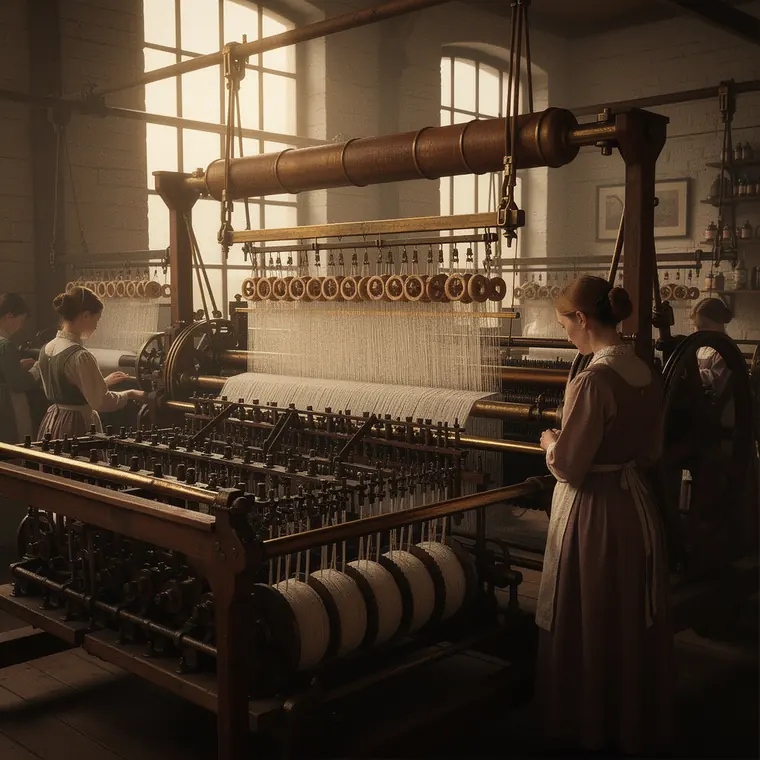
Bruegelmann's Cromford mill at Ratingen on the Anger: a tall five storey spinning house with regular rows of windows on every floor, a walled courtyard in front, a mill channel led from the river to a water wheel set against the building, the wheel turning under the mill, inside on the upper floors rows of wooden framed Arkwright water frames with upright spindles and bobbins below pairs of drawing rollers, driven by wooden shafts and gearing from the wheel, girls tending the spindles.
- What it was used for
- Johann Gottfried Brügelmann, a merchant from Elberfeld, had the three-storey Old Mill built on the river Anger near Ratingen in 1783; production started in 1784. On 24 August 1784 the Elector Karl Theodor granted him the privilege of spinning by machine for twelve years without competition, and by then the mill was already working. From the personnel lists Michael Knieriem has established 70 to 80 employed in 1784 and 226 in 1797; at times there were more than 600. Just under three quarters of the persons recorded in 1797 were children aged six to sixteen, with the eight to eleven age group most strongly represented.
- What was new
- What was new was not the machine but the single source of power: a single water wheel drove the machines on three floors, one above the other, and the pace no longer came from the individual spinner in a putting-out household but from the shaft. Museums and heritage registers list Cromford as the first factory of its kind on the European mainland, but none of them names a checked comparison case; the claim is handed down rather than tested. The technology was copied: Carl Albrecht Delius travelled to Britain in 1781-82, drew the machines and recruited skilled workers, and there was no licence from Arkwright. So the sovereign protected the copy against copying for twelve years, and Brügelmann, according to Knieriem, made his workers swear until the privilege expired to work for him for life, as part of his secrecy measures.
Further reading
- Portal Rheinische Geschichte (LVR), Eckhard Bolenz: Johann Gottfried Brügelmann
- Michael Knieriem: Cromford, Vorabend der Industrialisierung?
- Rheinische Industriekultur: Textilfabrik Cromford, Ratingen
- ERIH European Route of Industrial Heritage: Biografie Johann Gottfried Brügelmann
- LVR-Industriemuseum: Textilfabrik Cromford (Startseite)