Malakowturm Zeche Hannover
1857 · Brick Malakoff Tower · Work 321 of 1,871
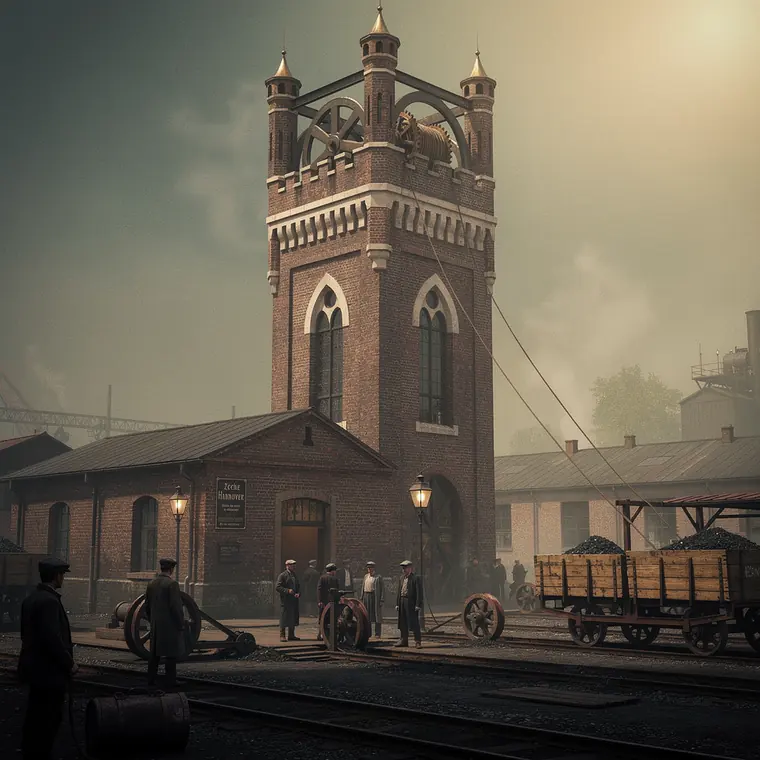
The castellated brick Malakow tower of Zeche Hannover in Bochum, a massive square tower of brick with corner turrets, battlements and pointed windows, the winding sheaves mounted inside the top of the tower directly over the shaft, the ropes running out from the tower to the engine house beside it, open wooden coal wagons standing on the yard tracks below, the yard lit by daylight only, miners in cloth caps and pit clothes crossing the yard.
- What it was used for
- The Malakow tower over shaft 1 of the Hannover colliery in Bochum-Hordel carried the sheave wheels and enclosed the shaft guide frame in a single masonry body. In 1872 Alfred Krupp bought the colliery to supply his cast steel works with coal; in 1905 some 2,400 miners worked at Hannover 1 and 2. The shaft depth is given as 739 to 750 metres and the peak annual output as 1,771,326 tons in 1965; the pit closed in 1973, the last in Bochum. The dating is disputed, and the regional authority contradicts itself: its museum pages say 1857, its own leaflet 1854 as the year of foundation, and KuLaDig dates the sinking of the shafts to 1859-60. None of the sources checked gives the thickness of the walls; ruhrzechenaus.de gives about 31 metres for the twin tower over shaft 2.
- What was new
- At the time of building, iron structures could not yet take the forces involved; the massive masonry tower took the tensile forces from the oblique pull of the ropes and also carried the sheave wheels. The name came from the Malakoff fort at Sevastopol, which fell in September 1855, though it only entered the technical literature in 1928 through Carl Koschwitz; in popular usage the towers had carried the name long before. The type was overtaken quickly. According to the structural engineers of the restoration it became obsolete around 1880, as soon as steel construction was capable enough. The tower then stood in working service for almost another century, and when the colliery was demolished in 1979 only the tower with its engine hall and the fan house were kept as an industrial monument.
Further reading
- LWL, Fremde Impulse: Bochum, Zeche Hannover und Siedlung Dahlhauser Heide
- LWL-Museum Zeche Hannover: Geschichte
- HEG Beratende Ingenieure: Sanierung Malakowturm Zeche Hannover Bochum
- ruhrzechenaus.de: Zeche Hannover in Bochum-Hordel
- KuLaDig: Zeche Hannover mit Kolonie und Volkspark in Hordel (O-89767-20140406-117)
- showcaves.com, Mining Technology: Malakowturm (Namensherkunft, Begriffsgeschichte)
- LWL-Industriemuseum: Faltblatt Zeche Hannover, Geschichte entdecken (Stand 02/2014)