Tomson-Bock
1858 · Timber Headframe · Work 323 of 1,871
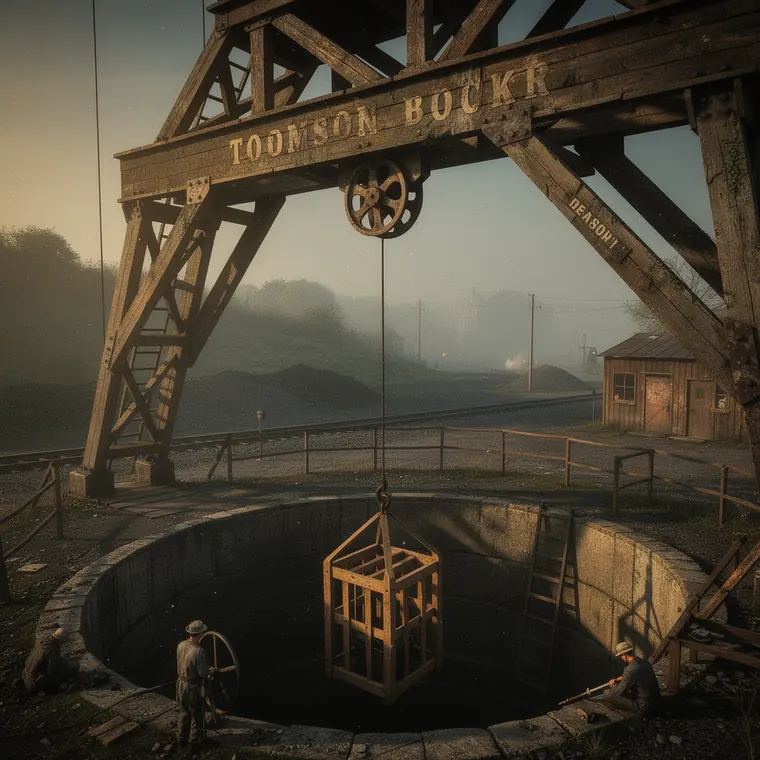
A Tomson bock headframe of braced timber beams leaning over a Ruhr coal shaft, its single sheave wheel carrying the flat wire rope down to a wooden cage at the collar.
- What it was used for
- Eugen Tomson, a Belgian engineer and from 1882 director of the Gneisenau colliery in Dortmund-Derne, submitted drawings for a steel headframe in 1885 and had it erected for the first time in 1886 over Shaft 1 of his own mine. The only surviving example stands on Shaft 2 of the same colliery, also dates from 1886 and has been protected since 1989; the LWL calls it the oldest steel headframe in the district. At the height of the coal industry, the industrial heritage foundation states, more than 100 of these frames were in use. One is left.
- What was new
- Tomson invented nothing from scratch. According to the LWL he took the so-called English frame as his model and made the structure sturdier while at the same time improving access to the shaft. The question here is therefore not who was first but what was improved on an existing type. The barb lies in the logic of lightweight construction: less mass for the same load. After Tomson's death in 1905 the lighter German strutted headframe gradually replaced the Tomson frame up to 1914. The one surviving frame is not the best one; it is the one that was not replaced.