Crowns Engine Houses
1835 · Cornish Engine House on the Cliff · Work 325 of 1,871
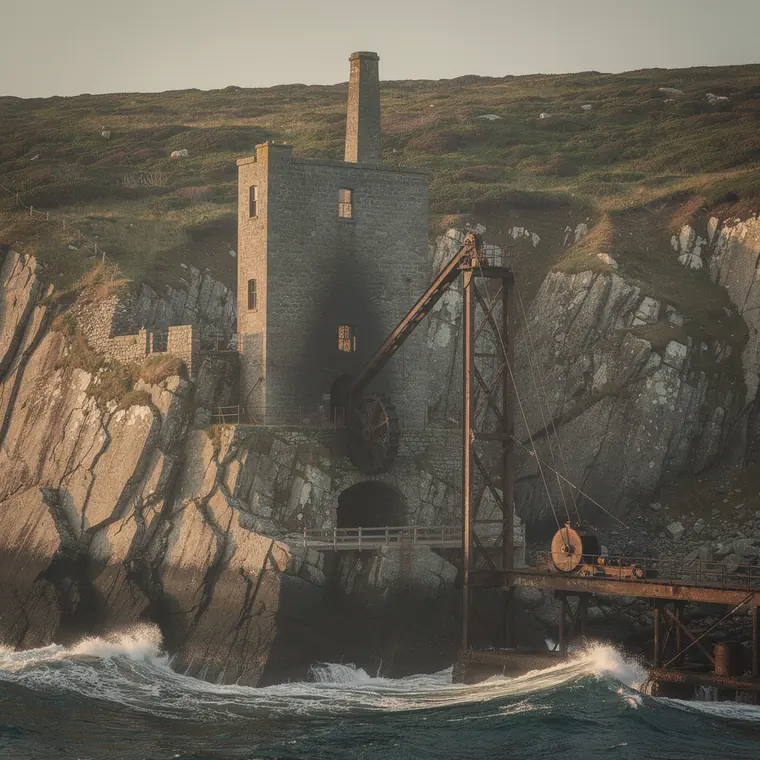
The Crowns engine house of Botallack Mine clinging to the granite cliff in Cornwall: a tall plain rectangular engine house of granite and brick standing on a rock ledge just above the sea at the foot of the cliff, its chimney stack built into its own wall and rising above the roof, a massive bob wall at the shaft end with the beam of the pumping engine nodding out over the shaft that runs out beneath the Atlantic seabed, the bare rock cliff rising behind, the sea breaking below.
- What it was used for
- Two engine houses on the cliff of the Crowns section of Botallack Mine near St Just, Cornwall. According to the National Trust the lower one held the engine that pumped water out of the shaft, the upper one a winding engine for men and materials. Cornwall For Ever dates the houses only to the 1830s and 1860s; the frequently quoted years 1835 and 1862 cannot be confirmed from the sources checked. The Boscawen shaft ran diagonally out beneath the sea bed, with about a third of the shafts and tunnels under the seabed. The figures are not clear-cut: the National Trust gives 664 metres for the diagonal Boscawen shaft, Cornwall For Ever a 375-metre shaft for the royal descent of 1865; the 570 metres the National Trust gives elsewhere refer to the mine's shafts as a whole.
- What was new
- Not a priority but a feat: a shaft driven diagonally out beneath the sea bed. The National Trust calls it "an engineering triumph", Cornwall For Ever applies "an engineering feat" to the engine houses; neither claims this was the first submarine mining anywhere. The barb is the sightseeing. Cornwall For Ever writes that the Crowns were a tourist attraction even while the mine was still working, and that after the visit of the Duke and Duchess of Cornwall on 24 July 1865 - named by the National Trust as the Prince of Wales and Princess Alexandra - underground tours became even more popular. Two years before that display, in 1863, a chain broke, and according to the National Trust eight men and a boy died. According to the National Trust the mine closed in 1895 and, after a brief revival, a second time in March 1914; Cornwall For Ever gives 14 March 1914.