Pferdegoepel
1780 · Horse Whim Winding · Work 327 of 1,871
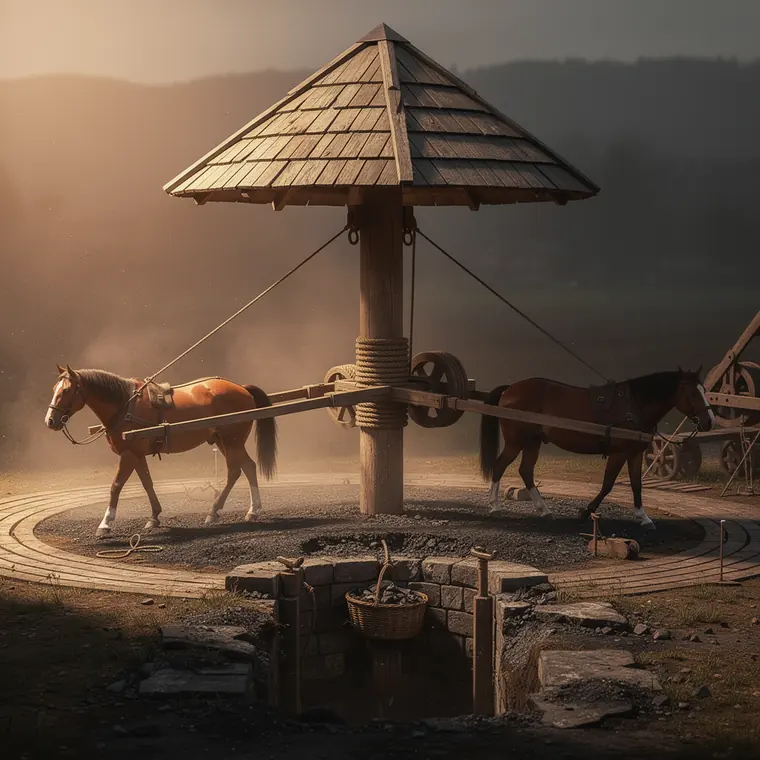
A horse whim beside a shallow coal shaft in the Ruhr valley, the whole machine standing at ground level under a low conical timber roof: a stout vertical wooden spindle planted in the ground carrying a large wooden rope drum near its top, two horses harnessed to long horizontal arms fixed to the spindle and walking a circular track on trodden earth beneath the drum, the rope leaving the drum horizontally over pulleys on a short wooden frame at the shaft mouth a few paces away, a basket of coal swinging over the shaft.
- What it was used for
- A documented example is the horse whim of the Neu Leipziger Glueck mine at Johanngeorgenstadt in the Ore Mountains. Two horses and one horse driver raised ore and rock from a good 140 metres; two ropes wound in opposite directions carried two hoisting kibbles. At each lift the team had to step back a few paces so the kibble could latch and be emptied, then it was turned round - not continuous rotation but a rhythm of stopping, backing up and turning round. The whim house is a good 27 metres long and the roofed octagonal horse walk 13 metres high. Three such installations were built at Johanngeorgenstadt between 1721 and 1806; this one worked until 1915 according to Industriekultur Sachsen, until 1917 according to the mining trail.
- What was new
- The horse whim was not new in the eighteenth century - the technical account itself points out that Agricola's "De Re Metallica" already shows a very similar installation. The siting logic was old too: whims were built where water could not be brought to the site, and two horsepower made continuous hoisting from greater depth cheaper than several hand winches with a string of winch boys. The barb: here it was not the steam engine that displaced the whim. The railway came too late, electricity replaced the water wheels directly, and the whim ran until 1915 or 1917 and was restored in 1921 as a technical monument. It was demolished only when uranium mining needed the shaft. What stands today is a 1992/93 reconstruction on a different site, built from surviving original drawings.