Fairbottom Bobs
1760 · Newcomen Atmospheric Engine · Work 328 of 1,871
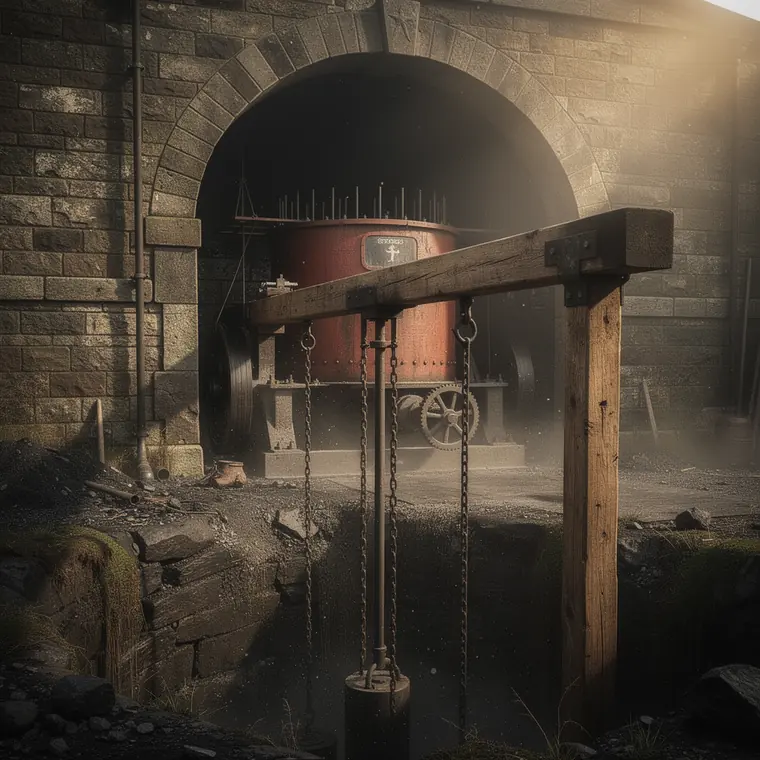
The Fairbottom Bobs Newcomen engine near Ashton-under-Lyne, its open-topped cylinder and arched stone house driving a timber beam whose chains lift pump rods from a coal pit.
- What it was used for
- A Newcomen-type atmospheric engine at Fairbottom near Ashton-under-Lyne in Lancashire. It pumped water out of a cannel coal mine in the Lancashire coalfield; The Henry Ford's collection record dates that use to "in about 1765". The engine was marked on Ordnance Survey maps under this traditional local name. The museum's data give a 28-inch cylinder bore, a 72-inch stroke, 11 horsepower and 14 revolutions per minute. The dating is uncertain: The Henry Ford lists the object as "circa 1750"and itself says: "Its early history is not known". When Henry Ford saw it in May 1928 it had been out of use for about a century.
- What was new
- Nothing about this engine was new; it is one of a series of a type that had been at work since 1712. What distinguishes it is a claim about survival, not invention, and it comes from the owning museum itself: The Henry Ford calls it "the oldest known surviving steam engine in the world". The barb lies exactly there. Ford did not buy it - the collection record gives the credit line "Gift of Earl of Stamford Trustees", and the museum text says the engine was presented to Henry Ford in 1929. It lay in ruin, and Ford charged Herbert Morton to dismantle, crate and transport "what remained of the original engine" to Dearborn, where Morton then oversaw the rebuilding. The world's oldest surviving steam engine is in part a Ford restoration, and it now stands in Michigan.