Koepe-Treibscheibe
1877 · Koepe Winding · Work 331 of 1,871
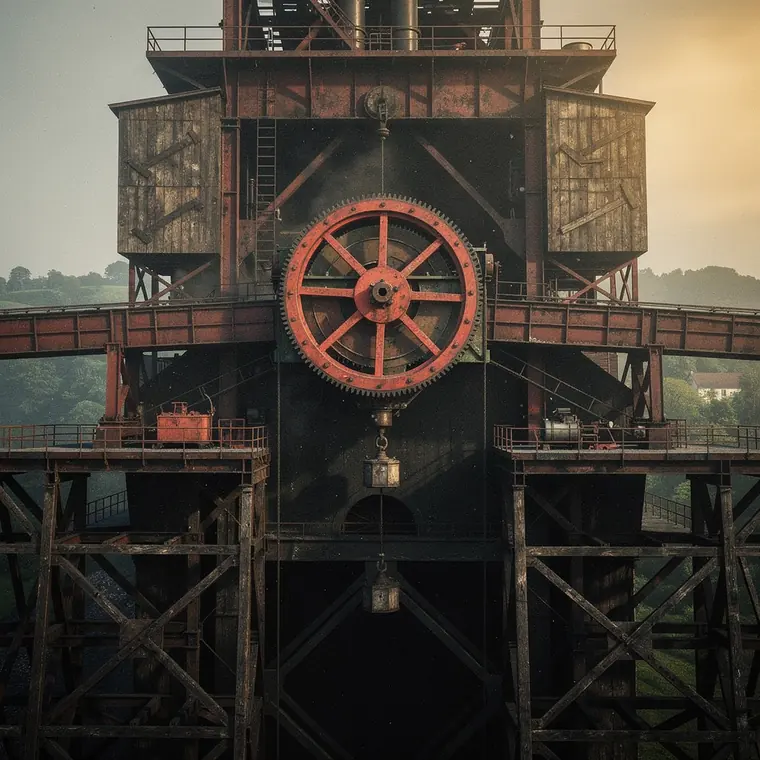
Friedrich Koepe's driving sheave at Zeche Hannover in Bochum, a single grooved wheel gripping one endless rope with counterweight, replacing the drum in the colliery engine house.
- What it was used for
- Friedrich Koepe was technical director of the Hannover colliery at Hordel near Bochum. There an old single-cylinder winding engine was rebuilt to his idea; a broadsheet by M. Neuerburg of Cologne dated 5 January 1878 describes the installation and gives the figures. The engine had been at work on Shaft I since 3 September 1877, the shaft was 234 metres deep, and daily output was 14,000 hundredweight in an eight-hour shift. Each lift raised 40 hundredweight of coal - as much as before, but with 10 instead of 18 revolutions of the engine, so that according to Neuerburg steam consumption stood to the former in the ratio of 10 to 18. Patent DE 218 was filed on 31 July 1877 and runs from 1 August 1877.
- What was new
- The rope is no longer wound onto a drum but runs by friction over a sheave, with cages at both ends balancing each other; claim 1 of patent DE 218 claims exactly that - a sheave with a single rope laid over it, moved by friction at its circumference. The difference in one sentence: a drum has to grow with the depth because it takes up the whole rope, whereas a driving sheave stays the same size however deep the shaft. The barb came from Koepe's own employer. As the Historical Society of Herne/Wanne-Eickel tells it, a Krupp commission judged that the rope would slip through - that is, the very friction the method rests on. According to the NDB, Krupp declined to take out the patent, Koepe had it granted in his own name, and Krupp called for the patent document in 1879 and then let the patent lapse.
Further reading
- M. Neuerburg, Ueber den Umbau einer Fördermaschine mit theilweiser Anwendung der Koepe'schen Patente, Flugblatt Köln 5.1.1878 (Bergbau-Archiv Bochum, BBA 20/855), im Portal Westfälische Geschichte des LWL
- Patentschrift DE 218 C, Fördermaschinenanlage mit vollständiger Seil-Last-Ausgleichung nebst Fangvorrichtung, Friedrich Koepe, Zeche Hannover bei Bochum
- Deutsche Biographie (NDB), Koepe, Friedrich
- DPMA, Postergalerie der Erfindungen: Treibscheibe (PDF)
- Historischer Verein Herne/Wanne-Eickel, Carl Friedrich Koepe