Fahrkunst Grube Samson
1837 · Man Engine with Counter Rod · Work 333 of 1,871
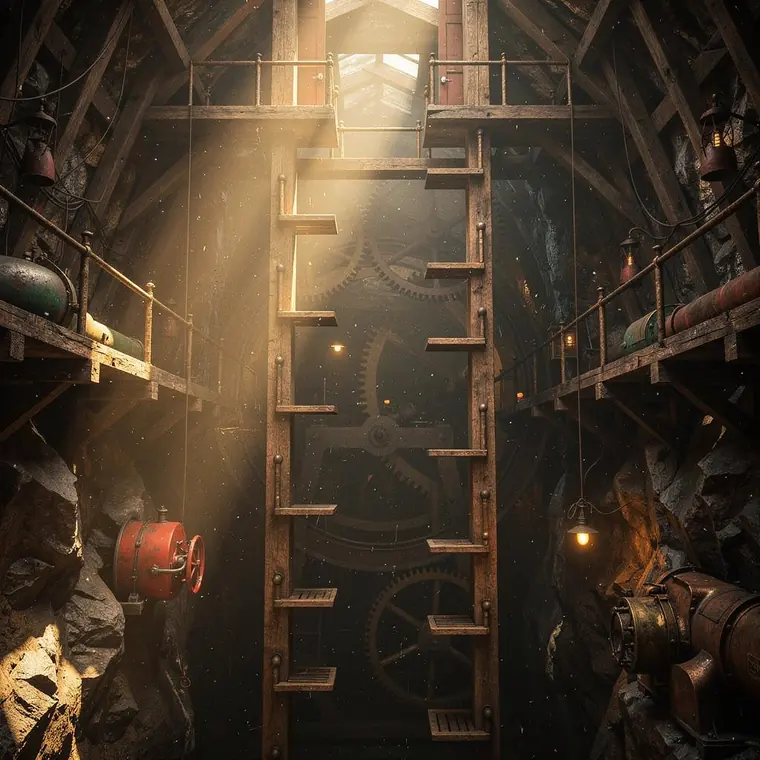
The man engine at Grube Samson in Sankt Andreasberg, two wooden rods with footboards and handholds moving in opposite strokes as miners step across between them in the narrow shaft.
- What it was used for
- The Samson mine at Sankt Andreasberg in the Upper Harz worked mainly silver ores from 1521 to 1910. Before the man engine the miners climbed in and out by ladder: 90 minutes down in the morning, 150 minutes up in the evening, four hours a day in all, which did not count as working time and was not paid. With the man engine a miner needed about 50 minutes for a shaft 600 metres deep. He stepped across between the footboards of two counter-moving rods; the museum writes that exactly one second is available for the change, that no safety harness is possible, and that because the lamp had to be carried only one hand was free to grip. Between 1837 and 1910 six miners were killed on the Samson man engine.
- What was new
- In 1833 Doerell transferred the principle of the vertical pump rods of the drainage system to carrying people. The first installation was in the Spiegelthaler Hoffnung shaft, double-acting, made of wood, with a 1.25-metre stroke and about five strokes a minute. What was new about the Samson installation of 1837 was the material: it was made not of wood as usual but of the wire rope invented in 1834, and that is precisely why it still exists. The method reached Cornwall through Michael Loam, who built the first Cornish man engine at Tresavean in 1842 "adapted from a German design" to win a Royal Cornwall Polytechnic Society competition. The barb: the machine outlived its mine. The last shift went down on 31 March 1910, since 1912 the water has driven turbines, and in the Ruhr the seven man engines were removed again after some twenty years on average.