Spedding Steel Mill
1750 · Steel Mill Spark Light · Work 334 of 1,871
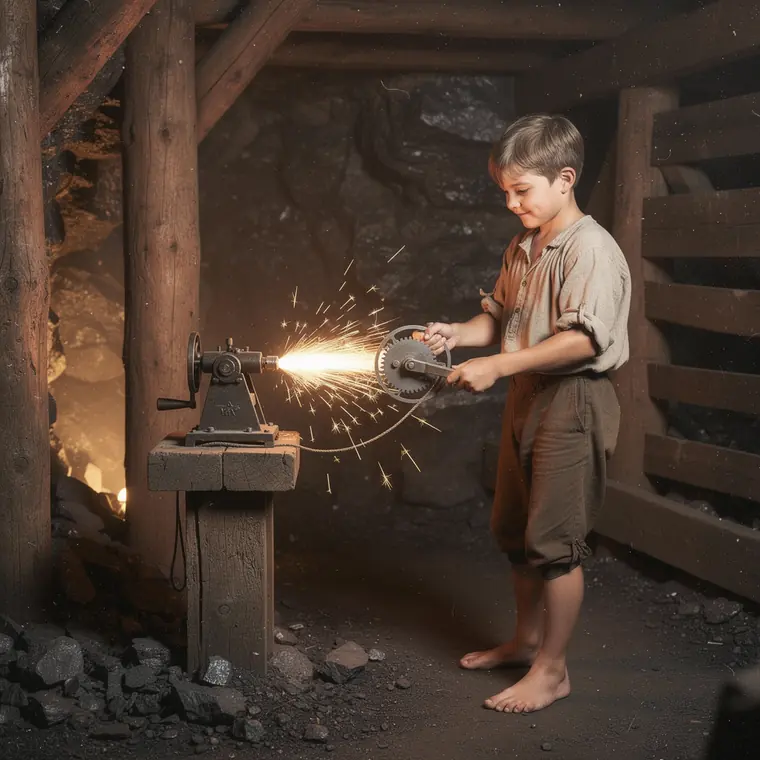
A hand-cranked flint and steel spark mill, a small wrought-iron frame clamped to a timber prop in a mine gallery: a winch handle turned by a boy of about twelve in a ragged coarse linen shirt with the sleeves rolled, loose breeches tied below the knee, barefoot, his hair unkempt, a pair of spur gears stepping up the speed, and a small toothed steel disc about a hand's breadth across spinning fast while the boy holds a piece of flint against its rim and throws a shower of sparks as the only light, the whole device no larger than a lantern, coal face beyond.
- What it was used for
- A hand-cranked spark mill for light in firedamp-prone coal mines, attributed to Carlisle Spedding, mine manager to Sir James Lowther at Whitehaven. A boy turned the handle and held a flint against the revolving steel disc so that a stream of sparks was produced and the hewer beside him could see. The disc of the Science Museum Group's example is 5.5 inches across and is driven through spur gearing at five times the speed of the winch handle. The museum describes the device as used by the colliers of northern England to give "light in places subject to fire-damp". There is no year of invention, only a range: the museum dates the object 1730 to 1750, and the paper by Kraft, Samay and Stutzer likewise dates the invention between 1730 and 1750.
- What was new
- What it could do: give light at the working place without an open flame, struck mechanically instead of burnt, so that workings could be entered which no candle or oil lamp could reach. No claim to being the first safety light appears in any of the sources. The barb is the device itself. The Science Museum Group writes that under certain circumstances the sparks would cause an explosion and that these mills quickly disappeared once the safety lamp arrived; Kraft dates the realisation to the run of explosions at Wallsend in 1783 to 1786. Then there is the light itself: Kraft calls it a fluctuating, feeble source of light obtained with great effort, and reports that several mills were occasionally worked together at one place to produce adequate light - several boys turning several sources of ignition. Spedding died on 8 August 1755 in his sixtieth year; Kraft attributes his death to an explosion induced by a Spedding steel mill, and calls that ironic.