Mueseler Lamp
1840 · Safety Lamp with Sheet Metal Chimney · Work 336 of 1,871
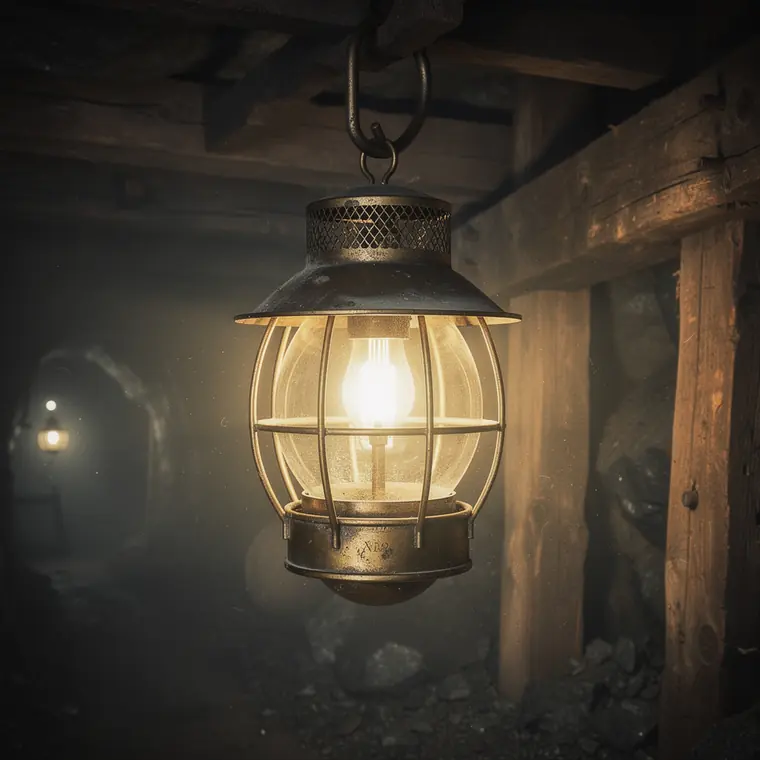
A Mueseler safety lamp in a Belgian coal gallery, its sheet metal chimney standing inside the gauze above a glass ring, the brass base carried by a miner's leather belt hook.
- What it was used for
- The lamp of the Liege mining engineer Mathieu Mueseler was compulsory in Belgian coal mining. Under the general mine police regulation of 28 April 1884 mines of the second and third category could, with one exception, use only lamps of the Mueseler type, fed with pure vegetable oil; the Blegny-Mine museum gives 1840 as the year of design. A Dutch collectors' site names a requirement by the Rogier government as early as 1864, without archival evidence. An intervention is shown by an example in the German Mining Museum at Bochum, made in 1901 by Cosset-Dubrulle of Lille: the device permitting it to be opened only when extinguished is missing, and the locking pin has been filed off - according to the museum possibly on purpose, because the lamp was closed with a lead-rivet seal instead.
- What was new
- Not a new principle but an addition: the 1877 Encyclopaedia Britannica describes the lamp as a form of Clanny's which differs from it by a conical chimney above the flame producing a rapid draught and so cooling the glass cylinder better. What it could do: go out rather than ignite when the mixture became explosive. The barb comes from the Belgian mines administration itself. Victor Watteyne wrote in the Annales des mines de Belgique in 1904 that it was now recognised that in such currents the flame of the Mueseler lamp passes almost at once into the upper gauze, and that in a fast current ignition of a firedamp-laden atmosphere is then a matter of seconds. The lamp was safe in horizontal air currents but not in oblique or vertical ones - frequent underground, and the explanation for ignitions when a lamp was dropped. It could be blamed for: Escouffiaux in 1887 with 35 victims, Anderlues in 1892 with 160 and Crachet-Picquery in 1898 with 16. The requirement was dropped in 1904.
Further reading
- Blegny-Mine / CLADIC, L'appareil d'essai des lampes de l'Institut national des mines (PDF, mit Zitaten aus Victor Watteyne, Annales des mines de Belgique, T. IX, 1904)
- Encyclopaedia Britannica, 9. Auflage, Bd. 6, Artikel Coal, Abschnitt Safety Lamps (1877), Digitalisat-Transkription
- Deutsches Bergbau-Museum Bochum / montan.dok, Öl-Sicherheitslampe Bauart Müseler, Inv. 030140706000
- mijnlampen.nl, De Mueseler-lamp