Wolf Benzinlampe
1884 · Petrol Safety Lamp with Magnetic Lock · Work 337 of 1,871
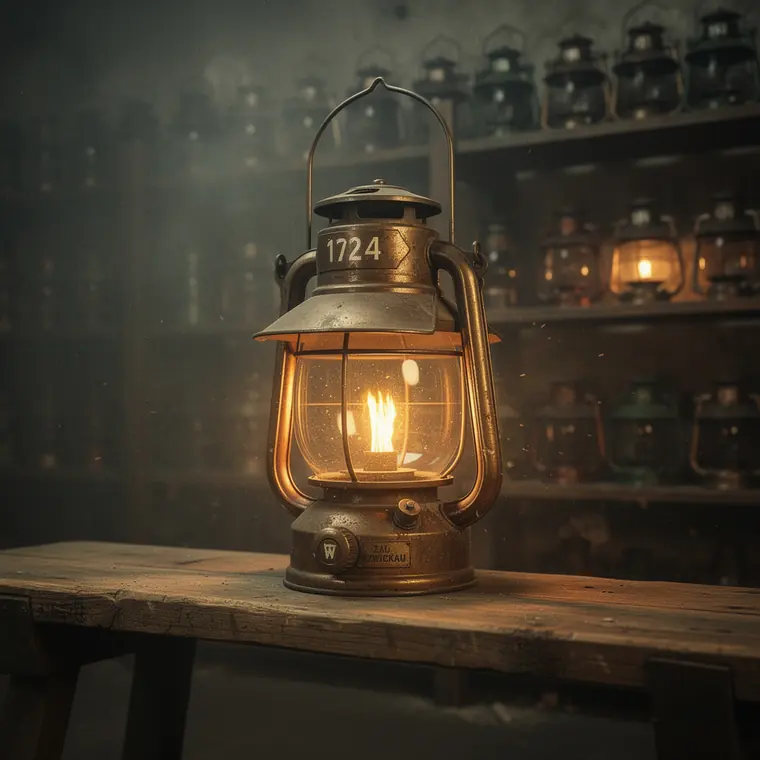
A Friemann and Wolf benzine safety lamp from Zwickau, its magnetic lock, bonnet and thick glass around the wick, set on a bench in the colliery lamp room among numbered lamps.
- What it was used for
- A benzine safety lamp for coal mining, built by Friemann & Wolf of Zwickau. It lit the working place and was at the same time the miner's gas test: with methane present a cap stood above the flame, flickering and extinction signalled higher concentrations. The Priesterhäuser Zwickau museum describes it with a double wire gauze and an inset igniter that allowed relighting without opening the lamp; the lamp could only be opened above ground. A compilation drawing on Heise/Herbst/Fritzsche, Bergbaukunde (1938), gives about 220,000 benzine safety lamps in use in Germany in 1899, some 146,000 of them in the Dortmund mining district alone, while oil lamps in the Ruhr fell from 50,700 to about 35,000.
- What was new
- What was new was not the safety lamp - Davy, Stephenson and Clanny had it between 1813 and 1815 - but the fuel and what it permitted: benzine has a lower flash point than oil, so the igniter could move inside the lamp. The date is disputed: the city of Zwickau and a collectors' chronology of the firm put the first lamp at 1881 and the patent at 1882, while the Priesterhäuser Zwickau museum says 1884, the year the company was founded. No patent number or office could be verified. The barb is in the same compilation: of 607 firedamp explosions in Prussia between 1900 and 1918, 357 were caused by the use of benzine safety lamps. The lamp against firedamp had become firedamp's commonest source of ignition.
Further reading
- Priesterhäuser Zwickau (Museum): Benzin-Sicherheitslampe
- Fränkisches Freilandmuseum Bad Windsheim: Mit Licht und Schutz durch das Schlagwetter
- foerdergerueste.de: Bergmännisches Geleucht und Grubenlampen (nach Heise/Herbst/Fritzsche, Bergbaukunde, 1938)
- mijnlampen.nl: Firmenchronologie Friemann & Wolf
- Stadt Zwickau: Die Benzinsicherheitslampe