Guibal-Ventilator
1862 · Mine Ventilation Fan with Paddle Wheel · Work 338 of 1,871
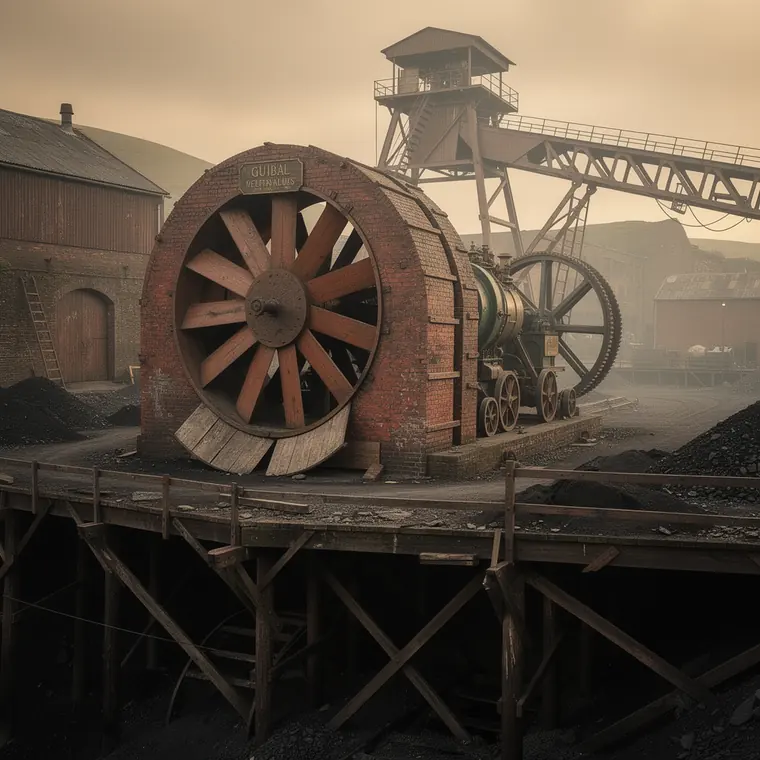
A Guibal ventilating fan at a South Wales colliery, its large wooden-bladed wheel enclosed in a brick spiral casing with an adjustable shutter at the mouth, driven by a horizontal steam engine.
- What it was used for
- A mine fan that drew stale air out of the shaft, designed by Théophile Guibal, a mining engineer at Mons. It replaced furnace ventilation, which moved air by burning a fire in the shaft. Historic England describes the surviving example at Skelton Shaft: 30 feet in diameter, 10 feet wide, 51 r.p.m., recorded in 1875 as drawing 110,000 cubic feet of air a minute, and calls Guibal fans the most common design used for mine ventilation in the nineteenth century. An 1875 estimate cited by Murray and Silvestre counts over 350 fans: 180 in England, 85 in Belgium, 60 in France, 30 in Germany. In Belgium in 1910, 256 of 355 ventilators were Guibals.
- What was new
- Not the first fan, but the combination of three things: a masonry casing, an adjustable sliding shutter that let the air quantity be regulated, and a chimney widening as it rose, plus blades angled backwards. Murray and Silvestre put its efficiency around 1890 at 51.3 per cent (their table for around 1850 gives 50 per cent for a furnace in the upcast shaft, 4 to 5.5 per cent for a furnace at the surface); a measurement at Staveley in 1881 gave 52.88 per cent, while Cochrane claimed 60 to 70 per cent before the mining institute at Newcastle in 1869. The year is disputed: Murray and Silvestre give Belgian letters patent of 3 June 1858 and experiments from 1855, Historic England says 1859, and no source confirms the date 1862. The barb: the Guibal could not be reversed, and the Coal Mines Act 1911 required exactly that; at Staveley the Guibals became standby units, at Skelton the fanhouse was adapted to reverse the air flow.
Further reading
- Historic England, List Entry 1420051: Guibal fanhouse, Skelton Shaft
- Murray & Silvestre, Lifecycles in Coal Mine Ventilation Technologies 1850-1914 (Economic History Society)
- Transactions of the North of England Institute of Mining Engineers, Vol. XIX (1869-70)
- Northern Mine Research Society, British Mining No. 28 (1985): Staveley notes
- Pleasley Colliery: Ventilation