Wettertuer im Durham-Revier
1842 · Plank Ventilation Door · Work 339 of 1,871
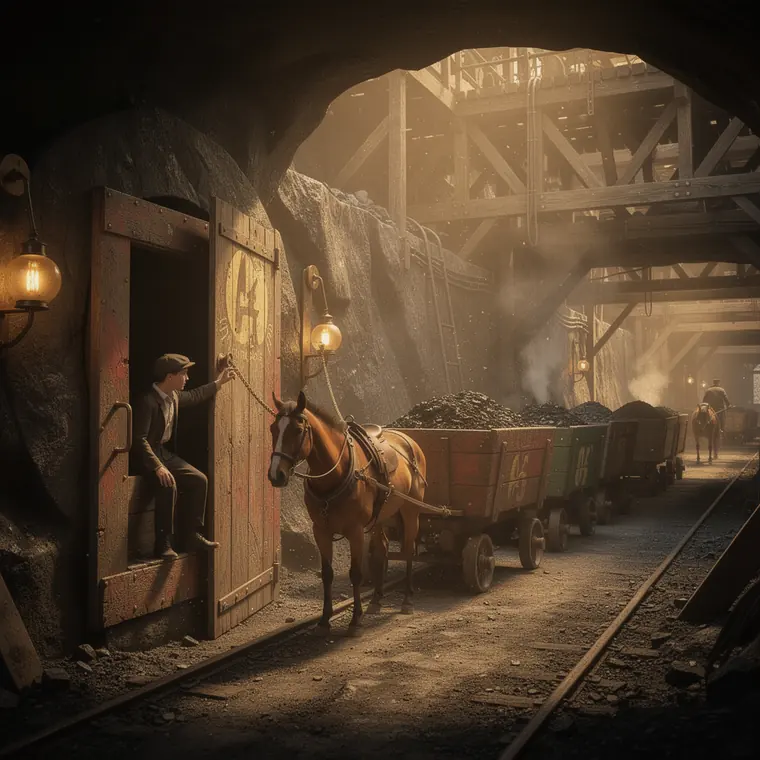
A trapper boy sitting in a niche beside a plank ventilation door in a Durham coal roadway, one hand on the string that opens it as a pony draws tubs through.
- What it was used for
- Ventilation doors split the air current underground and stopped fresh and foul air short-circuiting. The Children's Employment Commission report of 1842 for Northumberland and north Durham distinguishes main doors, man doors, sheth doors and sham doors; main doors usually stood in pairs, a kind of air lock for the rolleys, and the boys were instructed never to have two of them open at once. They were worked by the youngest children in the pit, the trappers. The report names door-keepers of seven, eight and nine, records cases of five-year-olds, twelve hours underground - commonly four in the morning to four in the afternoon - and average trapper earnings of 10 pence a day.
- What was new
- Nothing about the door was new; what was new was what went on record about it in 1842. The commission states the reversal itself: the lives of scores of adults, often including the boy's own father, hung on a child. The report notes that 34 people died at Jarrow in 1826 because an eight-year-old trapper left his door, and lists among the dead of the Willington explosion four door-keepers aged nine, two aged ten, one eleven and one thirteen. The technical remedy already existed: the viewer Charles Carr describes self-acting doors that made boys almost unnecessary, in use at five other Tyne collieries. Another witness proposes a mechanism never yet tried underground that might perhaps cost no more than keeping doors with boys. The 1842 Act banned boys under ten, not the twelve-hour door; the minimum age of twelve came in 1860.
Further reading
- J. R. Leifchild, Children's Employment Commission 1842, Report on the Collieries of Northumberland and the North of Durham (Volltext-Transkription, Coal Mining History Resource Centre)
- Durham Mining Museum: Mining Law (Selected Acts), 10 Aug 1842, 5 & 6 Vict. c. 99
- UK Parliament, Living Heritage: Coal mines