Albertseil
1834 · Twisted Wire Winding Rope · Work 341 of 1,871
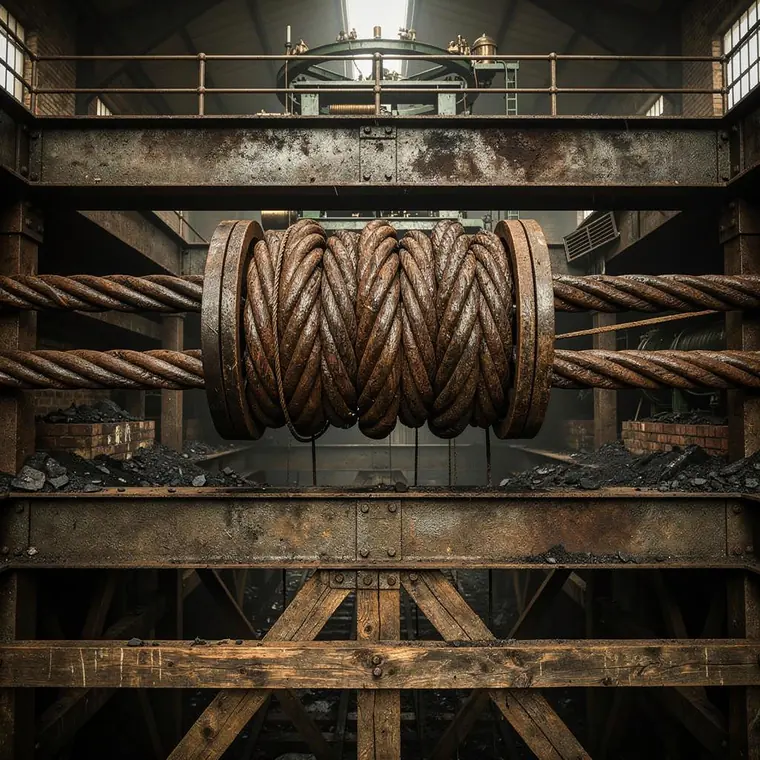
Wilhelm Albert's wire rope coiled at Clausthal in the Harz, three strands of twisted iron wires laid around each other, clamped to a shaft cage beside the older hemp rope.
- What it was used for
- A winding rope for the shaft. Hemp ropes wore out at great cost, chains failed under their own weight: at 400 metres a chain weighed several times the loaded ore tub and broke on that account. Wilhelm August Julius Albert, mining officer at Clausthal, had a rope made of iron wire with his mine smith Mummenthey. Christoph Bartels, in Der Anschnitt of the German Mining Museum at Bochum, dates the first wire ropes being hung to 22 and 23 July 1834, in the 484-metre shaft of the Carolina mine near Clausthal. Construction: three strands of four wires each, about 3.5 mm, an 18 mm rope, laid up in the same direction as the strands. It carried six times as much as a hemp rope of the same diameter and four times as much as a chain eight times its weight, and took up a third of the drum space.
- What was new
- What was new was not wire as a material but the lay: the strands and the rope twisted in the same direction, whereas fibre ropes had been laid in opposite directions as long as anyone could remember - the rope was free of wires crossing one another. Albert described the manufacture in 1835 in Karsten's Archiv für Mineralogie, Geognosie, Bergbau und Hüttenkunde, vol. 8, pp. 418-428 (so Bartels; the original printing was not consulted). The barb: the decisive advantage was not strength but that failure announces itself through single broken wires - the chain broke without warning. And the calculation that settled the matter was a cost calculation: by the end of 1838 the savings in the Clausthal, Zellerfeld and St Andreasberg districts were put at 23,481 thaler.
Further reading
- Christoph Bartels, Beispiele für die Verbreitung des Drahtseils, Der Anschnitt 62 (2010) H. 4, Deutsches Bergbau-Museum Bochum
- Roland Verreet, Eine kurze Geschichte des Drahtseils
- Conrad Matschoß, Oberbergrat Albert zu Clausthal, Zeitschrift des Vereines deutscher Ingenieure 52/22 (30.5.1908), S. 885-886
- Stadt Clausthal-Zellerfeld: Das Drahtseil (Archivfassung Februar 2025)