Grubenpferd im Durham-Floez
1850 · Pit Pony Haulage · Work 342 of 1,871
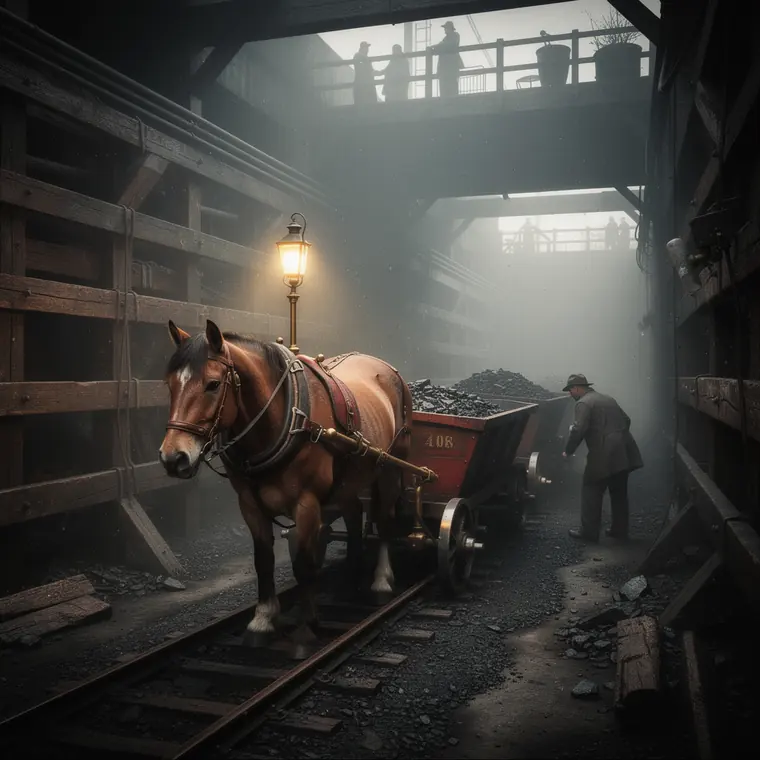
A pit pony in leather harness hauling a train of coal tubs along rails in a low Durham roadway, its driver walking bent beside the limbers with a lamp on the first tub.
- What it was used for
- Pit ponies drew trains of rolleys along the main roads to the shaft, while boys, the putters, pushed the smaller tubs from the face to the road. The Children's Employment Commission report for south Durham of 1842 describes several rolleys hooked one behind another and a distance of perhaps 30 miles in twelve hours. A tub held about 300 kilograms. The animals were stabled underground. Official stock figures start late: the House of Lords record of 28 March 1928 gives 65,210 ponies for 1924, 60,852 for 1925 and 56,852 for 1927 - and eight horse inspectors for 56,800 animals. For 1913 museums and specialist texts give about 70,000 ponies, Johnson citing the Government Digest of Statistics; that figure does not appear in the official reports.
- What was new
- For the year 1850 there is no stock statistic - that is a gap, not a number. What was new came with the third schedule of the Coal Mines Act 1911: one horsekeeper to every fifteen animals, record books of working time, a minimum age of four years, a ban on working a blind horse, dimensions for the stables. Dave Johnson calls these provisions the pit ponies' charter. The barb: the animal got its own rulebook and its own inspectors - in 1947 over 42,000 inspections were counted on 2,130 pit visits, two per horse - and went on dying: in 1925, 44 of every 1,000 ponies were killed in accidents, in Yorkshire 76. Two corrections: the 1842 ban on women's and children's underground work accelerated the use of ponies but did not put pony in the child's place - in 1842 both worked side by side at different tasks; and the last ponies left the large mines in 1994, Pant y Gasseg in Wales only in 1999.
Further reading
- Hansard (Lords), Pit Ponies, 28 March 1928
- Hansard (Commons), Pit Ponies (Conditions), 27 October 1948
- Children's Employment Commission 1842, Report by James Mitchell (South Durham)
- Dave Johnson, Pit Ponies, Eureka! (Juni 2006), S. 22-25
- Amgueddfa Cymru - Museum Wales: Welsh colliery horses
- National Coal Mining Museum for England: Pit Ponies