Kohlenhund
1800 · Wooden Mine Tub · Work 343 of 1,871
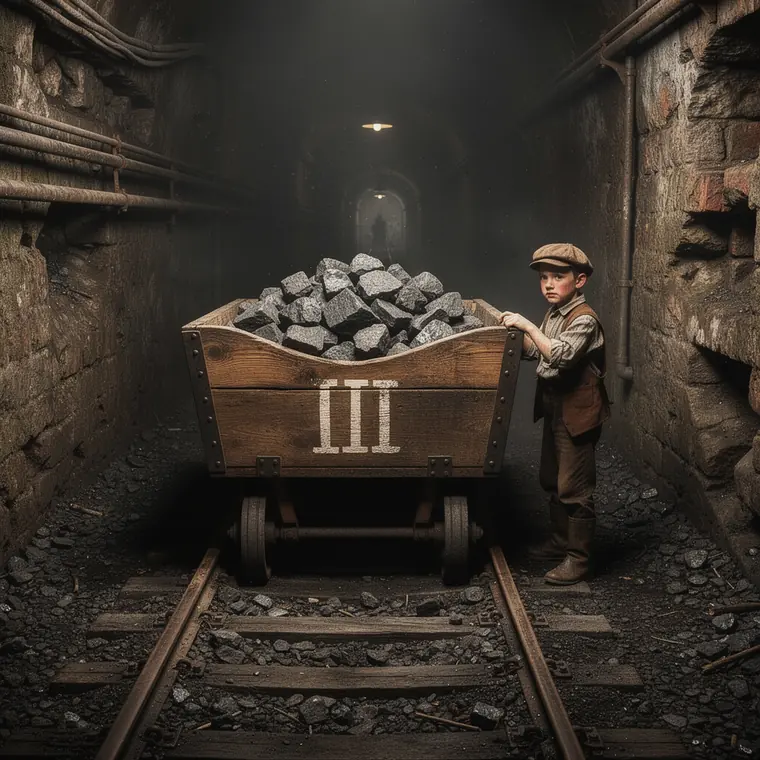
A wooden Hunt tub with iron-bound wheels pushed by a boy along plank rails in a Ruhr coal gallery, the box heaped with lump coal and a chalk tally mark on its side.
- What it was used for
- A wooden mine truck whose guidance lay not in the wheel but in the ground: a blunt pin under the box ran in the groove of a plank and kept the truck on track. Agricola describes it in 1556 in book six of De re metallica, in the Hoovers' 1912 translation: half as large again as a wheelbarrow, used for the longest tunnels because it moves more easily and takes a heavier load. Beate Falk, in Der Anschnitt of the German Mining Museum, describes the trucks being pulled by a chain and usually pushed by a second man at the same time; the workers were called Hundsläufer, Hundsschlepper, Hundsstößer. The wage relation at Schneeberg in the Passeiertal, in a note of hers: hewer 60 kreuzer a day, truck pusher 26.
- What was new
- 1800 is no date of invention; Falk traces the Hunt back to the sixteenth century. Nothing about it was new - what is disputed is its name, and the specialist literature says so openly. Agricola in 1556 derives it from the noise, Poppe in 1804 from dogs said to have pulled the trucks, Veit in 1871 and Grimm/Heyne in 1877 from Slovak hyntow and Magyar hintó in the sense of carriage, Falk in 2018 from the vocabulary of hunting. The mining museum's own 2015 companion volume says it is not settled why the truck is so called. The barb: the Hunt became the unit of pay - under the Wagengedinge, pay was tied to the number of trucks hauled, counted with wooden pegs on a tally board. The truck was pushed by men who, according to Falk, earned less than half a hewer's wage. That the flanged rail descends from the guide pin is not documented.
Further reading
- Agricola, De re metallica, Übersetzung H. C. & L. H. Hoover 1912, Buch VI, S. 156 (Digitalisat)
- Beate Falk, Der Hunt bzw. die Hunte im Bergbau - eine neue Namensdeutung, Der Anschnitt 70 (2018) H. 1-2, S. 36-40, Deutsches Bergbau-Museum Bochum
- montan.dok / Deutsches Bergbau-Museum Bochum: Strecke mit Holzgestänge für Spurnagelhunt, Grube Bastenberg, Ramsbeck
- Bergknappen-Verein Penzberg: Von Pferden und Hunten
- montan.dok / Deutsches Bergbau-Museum: Objekt des Monats - Das Zählbrett (Gedingetafel), 2021