Bickfords Zuendschnur
1831 · Safety Fuse with Powder Core · Work 344 of 1,871
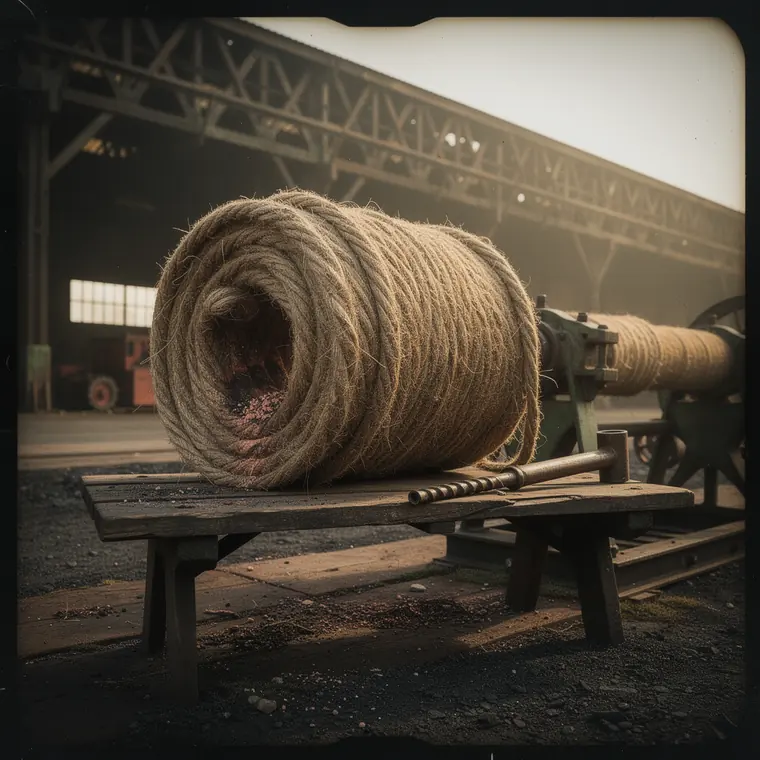
A coil of Bickford safety fuse on a bench at the Tuckingmill works in Cornwall, jute yarn spun around a powder core, beside the rope-walk machine and a shot hole tamping bar.
- What it was used for
- A means of firing black powder charges in drill holes. Before it, reeds or goose quills were filled with powder; the Cornish world heritage authority describes how these rudimentary fuses burned unpredictably and brought miners countless accidents involving blinding, loss of fingers, mutilation and death. Bickford's fuse carried a stream of powder in spun yarns, bound with twine and made waterproof with a varnish of tar. It burned without going out at a consistent 30 seconds per foot, so the burning time could be set by cutting to length. The works at Tuckingmill near Camborne made 45 miles of fuse in its first year of production and 160,000 kilometres a year a century later.
- What was new
- What was new was the predictable burning time. English patent No. 6159, entitled "Safety fuse for Igniting Gunpowder used in blasting Rocks, Etc.", was granted on 6 September 1831 according to the finding aid to the Ensign Bickford Archives at Simsbury Free Library, and according to this description concerned a machine and a process; the patent file itself was not consulted, and the number rests on this single source. The conception falls in the previous year, 1830. On the fibre the sources differ: the finding aid names flax, hemp or cotton, the world heritage site jute. The barb: William Bickford died in 1834, shortly before the factory opened - the firm bearing his name was built by others, and its own chronicle turns the absent profit into a virtue: the invention was made not for material gain but in the spirit of saving lives.