Doppelhandbohren in Dolcoath
1870 · Two Man Hand Drilling · Work 345 of 1,871
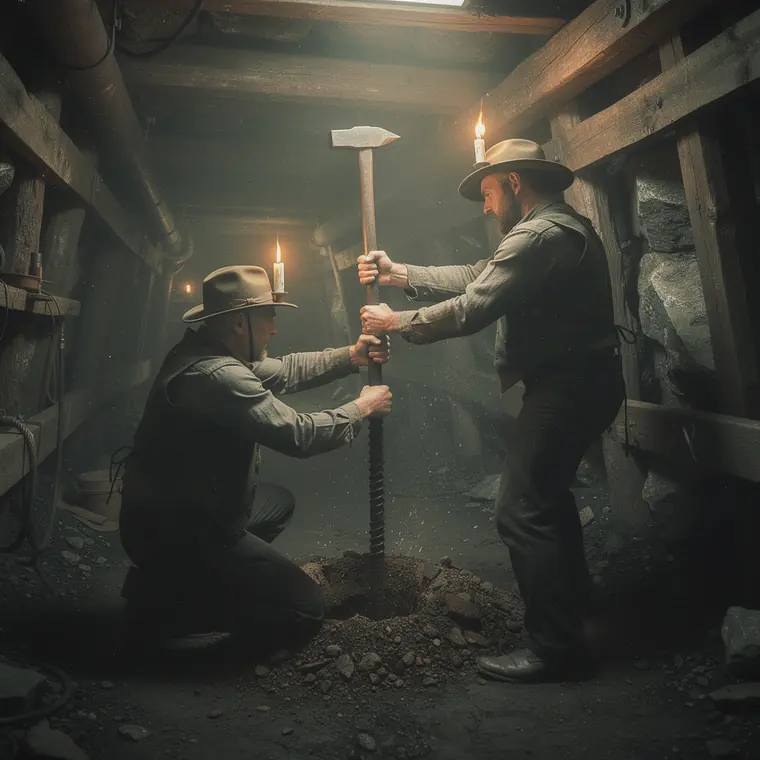
Two Cornish miners double-handed drilling in a level of Dolcoath tin mine near Camborne: a hand-held steel borer, a plain round bar of steel about an arm's length long with a chisel edge, one man kneeling and holding it against the rock face with both hands and turning it a little after each blow, the other standing and swinging a long-handled sledgehammer onto its head, the hole slowly deepening into the rock, rock dust packed in the hole, the miners in hats with candles fixed to them, the level lit only by candle flame.
- What it was used for
- Boring shot holes by hand, three men to a hole: one holds and turns the drill, two strike. Clement Le Neve Foster, HM Inspector of Mines, describes in his textbook the double-handed hammer of 6 to 10 pounds or more with a handle of two feet or more and gives the usual hole depth in driving levels by hand as 18 inches to 3 feet. For a Cornish boring competition he reports, citing the West Briton of 9 August 1888, that three men from Dolcoath bored 12.5 inches in 7 minutes 18 seconds at 130 blows a minute. Foster himself adds that such results only show what can be done under very favourable circumstances and for a very short time. Dolcoath was the deepest tin mine in Cornwall; in 1894 Foster puts its bottom level at 2,424 feet below surface.
- What was new
- Nothing about hand boring was new; what was new was the knowledge of its cost - and the incentive working against it. Foster writes in 1894 that wet boring holds back the dust which would otherwise be breathed and tends to cause lung disease - and in the same paragraph: where miners are paid by the depth bored, a higher price per inch is sometimes given for holes bored dry than for those bored wet. His table after the Registrar-General gives, for 1880 to 1882, Cornish miners aged 45 to 65 dying at 53.69 per 1,000 living against 25.11 for coal miners, while accident rates, in a table of Foster's reproduced by R. A. Williams for 1874 to 1882, were nearly equal: 2.63 per 1,000 for Cornish miners and 2.57 for coal miners underground. The difference came from the lungs. In 1904 the report of Haldane, Martin and Thomas to the Home Department established dust as the cause; a "Royal Commission" report of 1904 is probably a confusion with it.
Further reading
- C. Le Neve Foster, A Text-book of Ore and Stone Mining (S. 159-160, 670, 684, 701-702)
- R. A. Williams, The High Mortality of British Metal and Slate Miners, British Mining No. 34, Northern Mine Research Society 1987
- Cornish Mining World Heritage Site: Drills
- Grace's Guide: Dolcoath Mine
- C. Le Neve Foster, A Text-book of Ore and Stone Mining, 1. Aufl. 1894