Kohlentraegerinnen von Loanhead
1842 · Coal Carried in Back Baskets · Work 347 of 1,871
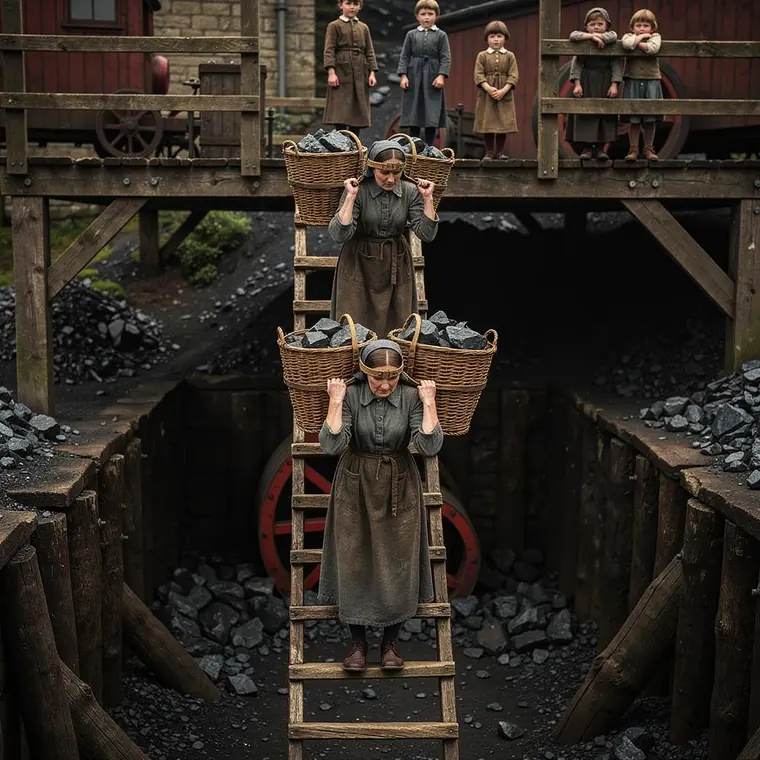
Scottish bearer women climbing a ladder stair from a shallow coal pit near Loanhead, each carrying a wicker creel of coal strapped over her forehead, children waiting at the top.
- What it was used for
- In the Scottish collieries women and girls carried the coal in a back basket, the creel, up ladders to the pit bottom or to the surface. Ellison Jack, eleven years old, told the commissioner Franks for Loanhead colliery near Edinburgh that her father took her down at two in the morning and she came up at one or two in the afternoon; her task was four to five tubs, each holding 4.25 hundredweight, and she filled five tubs in 20 journeys. Franks notes that she first had about 14 fathoms to travel from the wall face to the first ladder, that the ladders were 18 feet high, and that her load per journey was 1 to 1.5 hundredweight - at 112 pounds to the hundredweight, about 51 to 76 kilograms.
- What was new
- Technically there was nothing new in it; what was new was the publication. The 1842 report put the work on record, and within weeks the law followed: 5 & 6 Vict. c. 99, dated 10 August 1842, after the Commons had agreed the Lords' amendments on 6 August. The bill of 22 June 1842 was staggered - those already employed could stay, after three months the ban applied to those under eighteen, after six months to all females - and a Secretary of State might appoint inspectors if and when he thought fit. The barb: the ban took the wage, not the work. In the fields Mary Hogg got 8 to 10 pence a day, below ground a shilling, less oil, cotton and pit clothes; in 1843 petitions from Scottish collieries asked for repeal or amendment of the Act. The commencement date of 1 March 1843 could not be confirmed.
Further reading
- Children's Employment Commission 1842, Report by R. H. Franks, East of Scotland (Volltext, Coal Mining History Resource Centre)
- Scottish Mining Website: Text des Gesetzentwurfs vom 22. Juni 1842
- Hansard (Commons), Mines and Collieries' Bill, 6 August 1842
- Durham Mining Museum: Mining Law (5 & 6 Vict. c. 99, 10 Aug 1842)
- legislation.gov.uk: 1842 c. 99 (5 & 6 Vict.), Titel und Zitierweise
- Scottish Mining Website: Petitions by Colliers 1842-1843 (Anhang Petitionsausschuss, Session 1843)