Seilfahrt am Fuellort
1865 · Cage with Safety Catch · Work 348 of 1,871
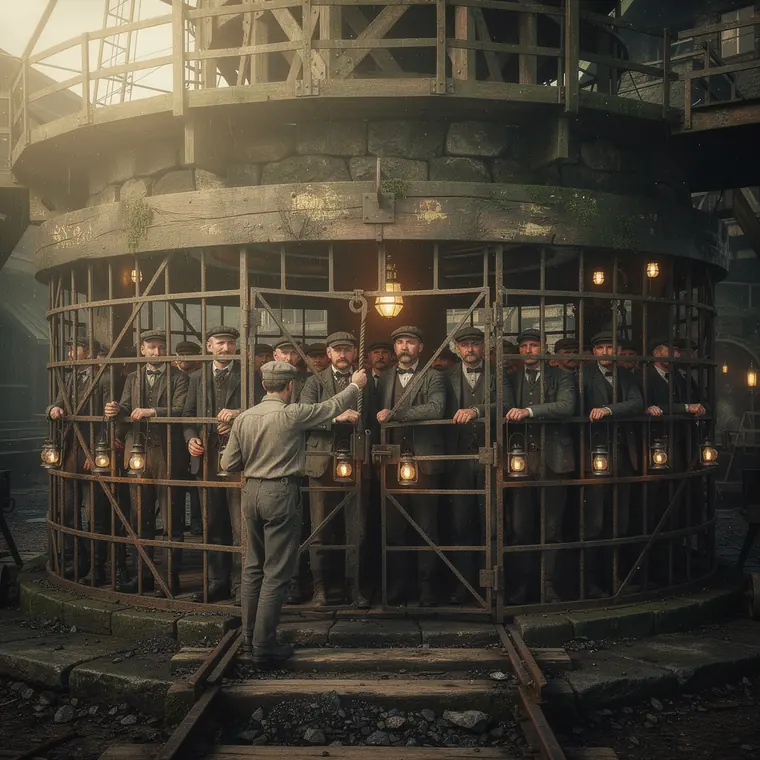
Miners standing shoulder to shoulder in an iron cage at the shaft collar of a Ruhr colliery, safety catches on the guide rails, the banksman closing the gate with tubs beside him, the men in soft cloth caps or leather caps, dark jackets and pit clothes, oil lamps in their hands, the shaft top lit by daylight from the windows of the shaft house and by oil lamps, iron bars, timber guides and wet stone.
- What it was used for
- The men riding the cage down to the pit bottom - in Lueger's technical encyclopedia the widened space at the shaft from which the roadways are driven into the field on each level and where shaft winding is handled. In the Ruhr the mining authority first permitted riding the rope in 1859. For men riding, Lueger names guidance of the cage on shaft guides and the catching gear, often fitted, whose purpose is to hold the cage on the guides after a rope break; before being brought into use, catching gear was tested in mock-ups of the shaft timbering. The man engine, ladder riding on moving steps, disappeared in the process: the last newly built Ruhr man engine went into service in 1865 and stood idle by 1883.
- What was new
- For Britain the question of a year of permission is wrongly put - the 1842 Act already laid down that the machine by which persons are raised or lowered in a shaft may only be in the charge of a male of fifteen years or more; no prohibition that was later lifted can be found. 1865, however, is a legal date: the Coal Mines Act of 7 August 1862 prohibited single-shaft mines, for new mines at once, for existing mines only from 1 January 1865 - and its fourth section let owners obtain extensions by arbitration. The trigger was Hartley: on 16 January 1862 the beam of the pumping engine broke, fell into the only shaft and shut in 204 people. The barb: the new way in became a new way to die. Ormerod's detaching hook against overwinding was patented in 1867, and in 1911 Masterman told the Commons that in the last five years 38 men had been killed and 239 injured in overwinding accidents; the hooks cost, according to Markham, £20 to £60.
Further reading
- legislation.gov.uk: Coal Mines Act 1862, 25 & 26 Vict. c. 79 (Originaldruck, [7th August 1862.])
- National Coal Mining Museum for England: The Hartley Calamity (16 January 1862, 204 Tote)
- Lueger, Lexikon der gesamten Technik: Füllort
- Hansard (Commons), Clause 40 (Provision of Winding Apparatus), 23 November 1911
- Science Museum Group: Ormerod self-detaching hook, patentiert 1867
- foerdergerueste.de: Fahrkünste im Ruhrgebiet
- Lueger, Lexikon der gesamten Technik: Fangvorrichtungen
- Lueger, Lexikon der gesamten Technik: Schachtförderung
- ruhrzechenaus.de: Hörder Kohlenwerk (1859 erste Seilfahrt-Erlaubnis im Ruhrgebiet)
- legislation.gov.uk: 5 & 6 Vict. c. 99 (1842), Originaldruck, Sect. VIII