Otto-Hoffmann-Koksofenbatterie
1881 · By-Product Coke Oven · Work 350 of 1,871
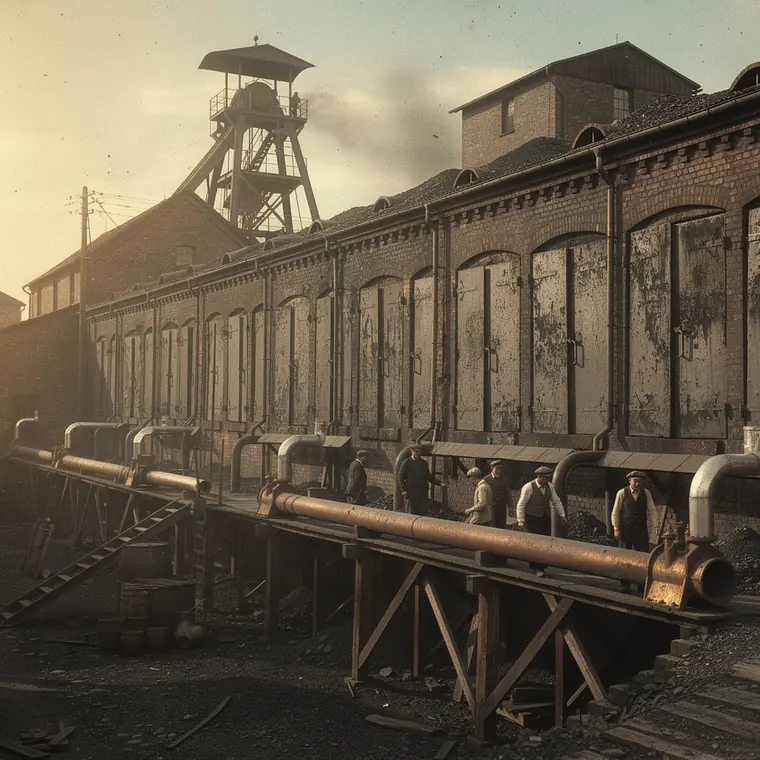
An Otto Hoffmann byproduct coke oven battery at a Ruhr colliery, a long straight brick block containing a row of tall narrow vertical coking chambers side by side, each a narrow slot with an iron door at either end, the row of iron doors standing along the face of the battery like a rank of upright panels, charging holes in the flat top, regenerator flues in the brickwork beneath, tar and ammonia pipes running along the working platform, men on the platform in cloth caps and waistcoats.
- What it was used for
- A coke oven battery that did not burn off the volatile matter of the coal but drew it away and used it: tar, ammonia, benzol, gas. The battery heated itself with its own gas and yielded surplus gas besides, which could be sold as town gas. Quantities per ton of coal, from the American HAER documentation of the by-product coke works at Birmingham: 8 to 12 gallons of tar, 20 to 28 pounds of ammonium sulphate, 2.5 to 4 gallons of light oil, 9,500 to 11,500 cubic feet of gas. The coke yield was higher too: a direct comparison in Alabama for 1925 gives 70.3 per cent for by-product ovens against 64.4 for beehive ovens. No German figure per ton of coal is documented.
- What was new
- Not the first by-product oven, and priority is disputed: Henry Simon secured the patent rights to Carvès's French ovens after 1878, Simon-Carves was founded in 1880 and built ovens at Pease's collieries in Durham in 1883, and the first American plant was built by Semet-Solvay at Syracuse in 1892. On this work's title: in 1881 Otto built his first by-product ovens (at the Holland colliery, per the Deutsche Biographie) and Hoffmann got his patent; the regenerative ovens followed in 1883 - in Silesia per the coke-oven engineers' association, at the Pluto colliery in Wanne per the Deutsche Biographie. And the Hoffmann in the name is Gustav Hoffmann, technical director at Dr. C. Otto, not Heinrich. His contribution was to transfer the Siemens regenerator to the Otto-Coppée oven, needed because recovering by-products cooled the gas. The barb: fertiliser and explosive came out of the same oven - the ammonia went onto the fields as ammonium sulphate, the benzol into paints and into TNT.
Further reading
- Hermann Toll, Geschichte der Deutschen Kokereibaufirmen, Verein Deutscher Kokereifachleute (VDKF) e.V.
- Deutsche Biographie (Bayerische Akademie der Wissenschaften): Otto, Carl
- Grace's Guide: Otto-Hoffmann (nach The Engineer, 25.06.1896)
- HAER, Thomas By-Product Coke Works, Birmingham (Library of Congress)
- Ruhr-Universität Bochum, Lehrstuhl für Wirtschafts- und Unternehmensgeschichte: Deutsche Kokereiindustrie
- Grace's Guide: Simon-Carves