Setzmaschine der Kohlenwaesche
1855 · Piston Jig · Work 351 of 1,871
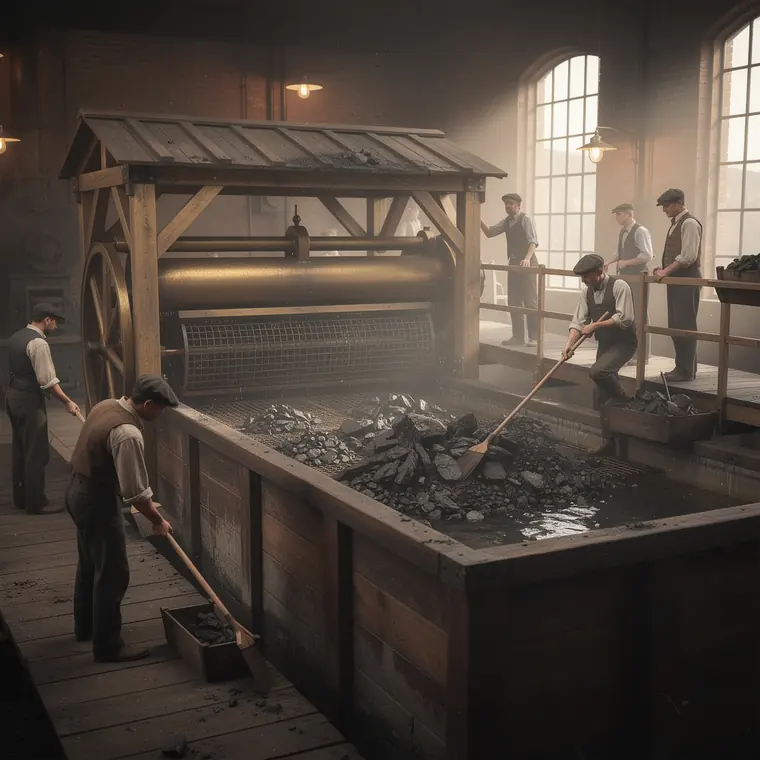
A coal washing jig in a Ruhr preparation plant: a timber and iron water tank with a fixed sieve, a piston plunger working up and down in the water beside it under a timber housing, coal and shale separating in layers on the sieve as the water pulses, men in caps, shirts and waistcoats standing on the plank walkway beside the tank raking off the refuse with wooden rakes, their boots on dry planks, the shed lit by daylight through the windows and oil lamps.
- What it was used for
- Separating coal from stone by density: on a screen deck in a pulsing water current the heavy sinks and the lighter stays above. Lueger's encyclopedia describes wet coal preparation as a chain of screening, jigging, crushing coal with adhering stone, dewatering, de-dusting and clarifying the wash water. The hand-worked jigging sieve, the basket dipped into water, is already in Agricola; mechanical pulsation came only with piston and plunger pumps. The Humboldt machine works at Cologne-Kalk built a first continuously working mechanical coal washery in 1860. How large this later became is shown by the washery of Zollverein shaft XII, built 1930 to 1932, with today five compressed-air jigs (SKB, about 1955) in two rows, for coarse, fine and re-washing.
- What was new
- Here the entry stays thin, and that belongs in it: for 1855 no event in the history of jigs or coal washing could be found; the year is conventional, not documented, but the 1905 technical volume reports, with reservations, a washery with hand-worked jigging boxes at Viktoria Mathias colliery as early as 1849 and further ones with hydraulic jigs by 1853. Baum's air-pulsed jig is documented only as appearing at the end of the nineteenth century; first name, year and company attribution could not be confirmed. What washing changed is stated in a technical volume of 1905 looking back: thirty years earlier almost the whole of the then some 11.5 million tons raised in the Lower-Rhine-Westphalian district had been shipped as raw coal. The barb: washing did not make better coal, it made poorer coal saleable. And it produced what it separated: for the sludge alone Zollverein kept three Dorr and three Hardinge thickeners and a flotation plant.
Further reading
- Lueger, Lexikon der gesamten Technik (1904): Kohlenwäsche
- Rheinische Industriekultur: Maschinenfabrik Humboldt, Köln-Kalk, Werksgeschichte (1860 erste ständig arbeitende Kohlenwäsche)
- KuLaDig (LVR/LWL): Kohlenwäsche der Zeche Zollverein 12 in Katernberg
- Aufbereitung, Kokerei, Gewinnung der Nebenprodukte, Brikettfabrikation, Ziegeleibetrieb (Springer, Berlin 1905), Kap. Geschichtliche Entwickelung
- Minerals 10(11):998 (2020): Jigging - A Review of Fundamentals and Future Directions