Cornish Stamps at Wheal Peevor
1876 · Stamp Mill with Iron Stamps · Work 352 of 1,871
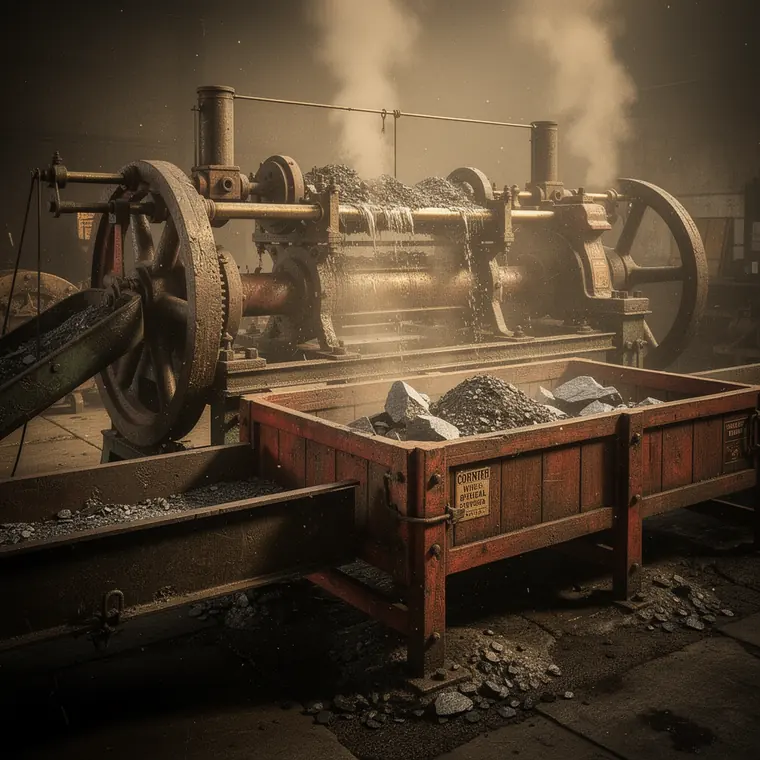
A battery of Cornish stamps at Wheal Peevor near Redruth, iron-shod lifters raised by cams on a rotating shaft to crush tin ore in the coffer, launders carrying slurry away.
- What it was used for
- Wheal Peevor near Redruth reopened in 1872 as a separate concern working primarily for tin. The stamps crushed the ore before it was dressed over buddles and calcined in two Brunton furnaces to drive off the arsenic. J. H. Collins gives the Cornish average in 1874/75: a stamp head of about 4 cwt, roughly 200 kilograms, about 40 blows a minute and close to one ton of stuff per head in 24 hours. Between 1872 and 1889 the mine produced 3,280 tons of black tin, according to Historic England. In the same passage Collins warns against over-stamping: crush too fine and you make slime, and much ore is then lost in the dressing that follows. The machine meant to liberate the tin could wash it away.
- What was new
- Nothing about Cornish stamps was new in 1876; the design is centuries old, and steam stamps had worked at the Carn Brea mines since 1813. What actually stood at Wheal Peevor is itself disputed: Simon Jones (Cornish Mine Images) and Explore Cornwall record Cornish stamps for the 1870s and twenty Californian heads only from 1912, while Barry Wills gives 48 Californian heads; Historic England says only "stamps", with neither type nor number. What the date marks is a turning point. Cornwall Council puts the peak of tin production in the 1870s and notes that from 1874 output declined as Australia and Malaya opened extensive shallow deposits. The mine was abandoned in 1887 because of the tin price, twelve years after the stamps engine house was built.
Further reading
- Historic England, Scheduled Monument 1004247: Part of the mining complex at Wheal Peevor, Redruth
- J. H. Collins, Principles of Metal Mining, §§135-137 (Archive.org, principlesofmeta00collrich)
- Cornwall Council / Cornish Mining WHS, History - overview (PDF)
- Cornish Mine Images (Simon Jones), Wheal Peevor Mine
- Barry Wills (MEI), Wheal Peevor - a forgotten historical mining gem (2018)
- Explore Cornwall, Wheal Peevor