Bal Maidens am Rundherd
1860 · Hand Dressing at the Buddle · Work 353 of 1,871
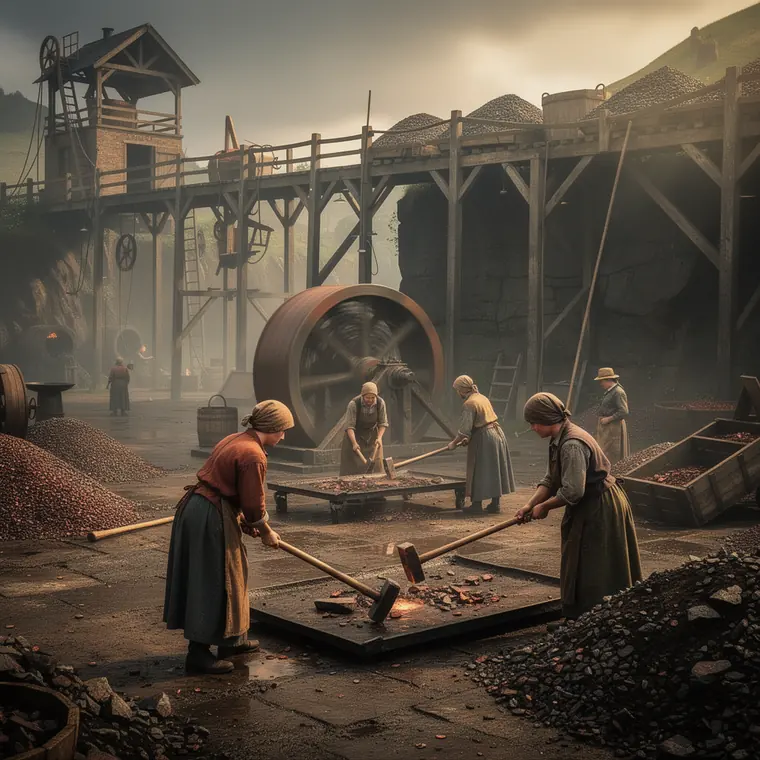
Bal maidens at a Cornish copper mine dressing floor breaking ore with long-handled bucking hammers on iron plates, a round buddle turning behind them and sorted ore in heaps.
- What it was used for
- Bal maidens were the women and girls of Cornish surface ore dressing. Charles Barham set out the sequence in his 1842 report to the Children's Employment Commission: riddling and spalling usually by girls of sixteen and over, cobbing at an iron anvil from about fifteen, then bucking, pulverising the ore on iron anvils, which he records as being considered about the hardest work the girls were regularly engaged in, paid at tenpence to a shilling a day. The working day ran ten hours in summer and about nine in winter, with a walk of two to four miles on top. Wages were paid monthly to one child on behalf of five or six; Barham notes that care was now generally taken to pay enough silver so the division could be made without going to the shop or public house for change.
- What was new
- There is no innovation here. The trade is documented from the Middle Ages on, and 1860 marks the turn, not the peak. The balmaiden.co.uk database records women employed in particularly large numbers from about 1770 to 1860, with numbers declining afterwards; Bernard Deacon counts over 5,000 bal maidens in Cornwall in 1861, close to nine per cent of unmarried women aged 15 to 69. Two forces pulled against each other. Collins wrote in 1874/75 that bucking was nearly superseded by crushing machinery, hand spalling costing 6 to 8 pence a ton against 3 or 4 for the stone breaker. Barham, in 1842, had observed the opposite effect first: machinery tended to substitute younger hands for those before employed. And the buddle itself, in his account, was chiefly boys' work; the more delicate work at the frames fell to the women.
Further reading
- Charles Barham, Children's Employment Commission 1842, Report on the Mines of Cornwall and Devon (Transkript, Cornish Studies Library / balmaiden.co.uk)
- Charles Barham, Children's Employment Commission 1842, Ages and Numbers of Children (Transkript)
- Lynne Mayers / Peter Boorman, Bal Maidens in Cornwall & Devon
- Bernard Deacon (Institute of Cornish Studies), Bal maidens
- J. H. Collins, Principles of Metal Mining, Glossar und §135 (Archive.org)
- Charles Barham, Children's Employment Commission 1842, Report on the Mines of Cornwall and Devon (Transkript, balmaiden.co.uk)
- Charles Barham, Children's Employment Commission 1842, Ages and Numbers of Children (Transkript)
- Lynne Mayers / Peter Boorman, Bal Maidens in Cornwall & Devon