Breaker Boys
1890 · Coal Breaker with Women Pickers · Work 354 of 1,871
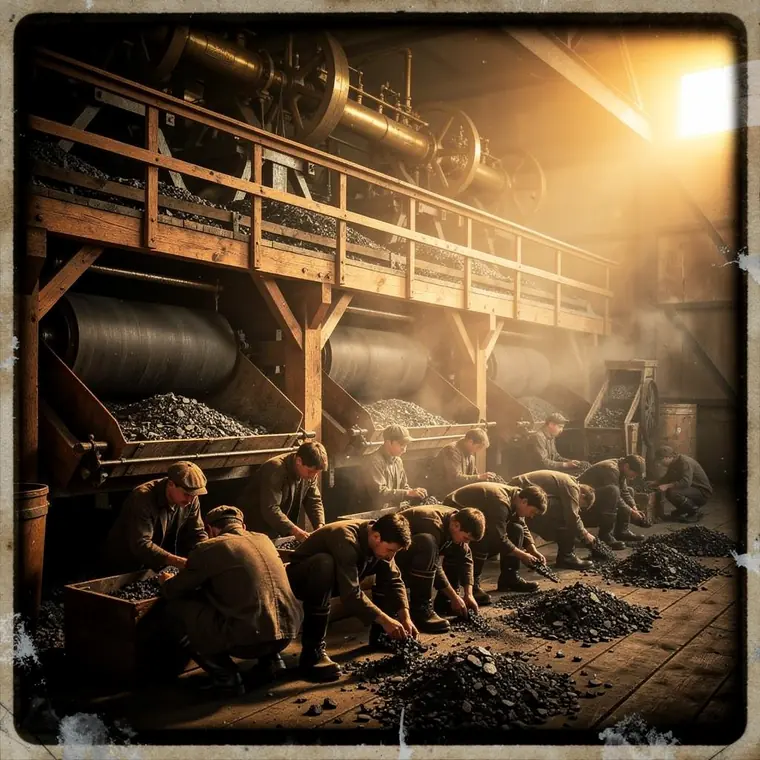
Breaker boys bent over chutes inside a Pennsylvania anthracite breaker, picking slate from the coal running past their boots, the wooden building's rollers and screens rising above them.
- What it was used for
- In the breakers of the north-eastern Pennsylvania anthracite field, boys picked slate out of the coal running down the chutes. They sat on boards across the chutes, several to a chute, each catching what the boy above him had missed; gloves were widely forbidden because management believed they made it harder to feel the slate. Francis H. Nichols described the hours in McClure's Magazine in 1903 - seven to noon, one to six, and in busy times to half past six: "For his eleven hours' work the breaker boy gets no more pay than for ten." A beginner was paid forty cents a day, the average about seventy. Nichols cites the Pennsylvania Bureau of Mines report for 1901: of 147,651 people employed in and about the mines of the anthracite region, 19,564 were classed as slate-pickers - a category that also included crippled and superannuated miners.
- What was new
- Nothing here was new. What 1890 marks is a high point of child labour: the Bureau of Labor Statistics states that from 1890 to 1910 no less than 18 per cent of all children aged 10 to 15 worked, and Pennsylvania was far ahead of its neighbours. The figures are soft, because the state counted slate-pickers rather than boys; the Department of Mines report for 1905 covers only those aged fourteen to sixteen - 8,121 of them - and admits that inspectors doubted whether 760 had reached the legal age. It was not the law that ended the work. Lewis Hine, the photographer of child labour, captioned his own 1913 picture of a picking machine with the claim that it let through 1 to 2 per cent slate against 15 to 60 per cent for the boys - a caption figure, not an independent measurement.
Further reading
- McClure's Magazine, Februar 1903, Bd. XX Heft 4 (Archive.org), darin Francis H. Nichols, Children of the Coal Shadow
- Report of the Department of Mines of Pennsylvania, Part I Anthracite, 1905 (Archive.org)
- Perry K. Blatz, The All-Too-Youthful Proletarians: Breaker Boys of the Anthracite Coal Region, Pennsylvania Heritage (PHMC), Winter 1981
- Library of Congress, NCLC collection, Lewis W. Hine, Langerfeld picking machine, 18. März 1913 (LCCN 2018674793)
- U.S. Bureau of Labor Statistics, Monthly Labor Review (2017), History of child labor in the United States