Salamanca
1812 · Blenkinsop Rack Locomotive · Work 355 of 1,871
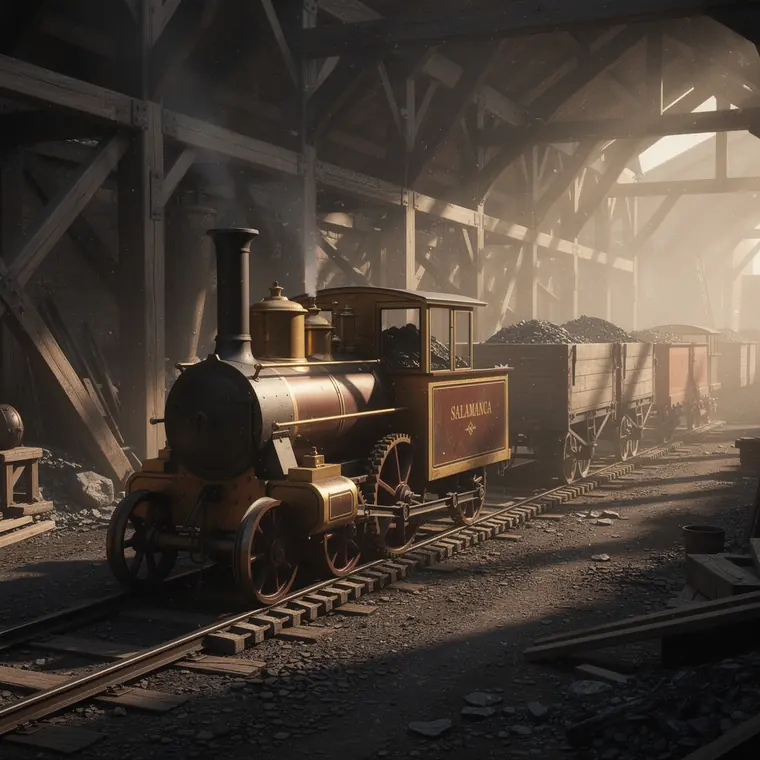
Blenkinsop's locomotive Salamanca on the Middleton Railway at Leeds: a short four-wheeled engine, two vertical cylinders sunk into the top of the boiler along its centreline, their piston rods rising above the boiler to crossheads sliding in guides and connecting rods driving cranks, a large toothed cog wheel on the left side outside the frame engaging a rack of teeth cast along the outer side of one rail, the four plain carrying wheels not driven, a chimney at one end, drawing loaded open wooden coal wagons towards the town staith.
- What it was used for
- Matthew Murray built four locomotives at Fenton, Murray & Wood in Leeds for Charles Brandling's Middleton Railway, which carried coal some three and a half miles from the colliery into Leeds. They ran under the patent of the colliery viewer John Blenkinsop, GB 3431, obtained 10 April 1811, which describes a rack laid along one side of the road engaged by a toothed wheel driven from the cylinders. The Engineers and Mechanics Encyclopedia of 1839 passes on, via Partington, Blenkinsop's own statement that his engine drew 27 wagons of 94 tons on a dead level at three and a half miles an hour and did the work of sixteen horses in twelve hours. The occasion was the price of fodder: the Peninsular War had made horses expensive. On 28 February 1818 the boiler of one of the engines burst and killed the driver, George Hutchinson.
- What was new
- Not the first steam locomotive: Trevithick ran at Penydarren in 1804, and from 1813 William Hedley at Wylam pursued adhesion without a rack. What was new was sustained service. The Science Museum Group calls Middleton the first enterprise in which the steam locomotive was used with financially successful results, and it ran for some two decades. Technically the point was that Murray used two cylinders set out of phase, so the engine would start again from wherever it came to rest, without being turned by hand. The name needs a correction. The first trial ran on 24 June 1812, but the battle of Salamanca was not fought until 22 July; on the MyLearning account Salamanca was the second engine, put to work for the formal opening on 12 August 1812. Putting both dates in one sentence merges two locomotives.
Further reading
- Dictionary of National Biography, 1901 supplement, Blenkinsop, John
- MyLearning (Leeds Museums), The Rack and Pinion Railway - John Blenkinsop
- Engineers and Mechanics Encyclopedia 1839: Railways: John Blenkinsop (Grace's Guide)
- Science Museum Group Collection, Model of Blenkinsop rack locomotive, Objekt 1910-21
- South Leeds Life, Epic transatlantic journey to rediscover historic blast from the past
- Science Museum Group Collection, 'Puffing Billy' Locomotive with Tender and Rails, Objekt 1862-2
- National Army Museum, Battle of Salamanca