Locomotion No. 1
1825 · Colliery Locomotive with Coupling Rods · Work 356 of 1,871
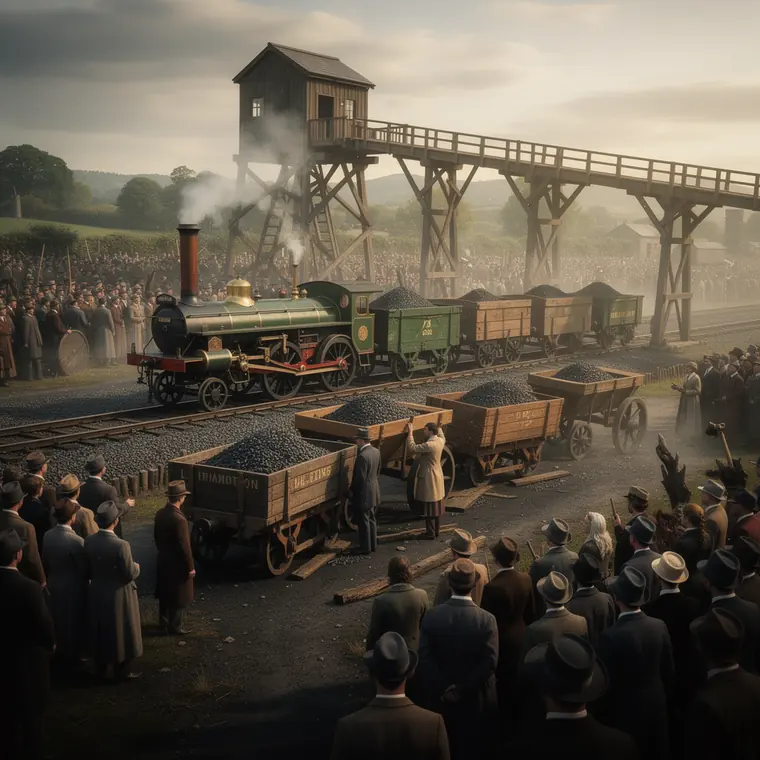
Locomotion Number One on the Stockton and Darlington Railway on opening day, a small four-wheeled engine with all four wheels coupled by rods, a plain cylindrical boiler with a single tall chimney at the front end, two vertical cylinders set into the top of the boiler with their cross-heads and rocking beams working above it, a small tender behind, hauling chaldron wagons of Durham coal past a lineside crowd in top hats, tail coats, breeches, smocks and bonnets.
- What it was used for
- Robert Stephenson and Co. built the engine at Newcastle in 1825 for the Stockton & Darlington Railway, to bring coal from the pits near Shildon down to the port at Stockton. At the formal opening on 27 September 1825 it drew a mixed train of coal, flour and passenger wagons the first twelve miles in about two hours; Historic England gives around 600 passengers, a contemporary newspaper report 1,000. The Science Museum Group collection record, object number 1978-7010, gives a weight of 6,500 kilograms. In 1828 the boiler burst and the driver, John Cree, died two days later. Timothy Hackworth rebuilt the engine with a new boiler; it was withdrawn in 1841.
- What was new
- The steam locomotive was not new, and in 1825 the railway did not yet run a regular steam-hauled passenger service. Historic England records that after the opening the company let passenger traffic to contractors who ran horse-drawn coaches over the rails for a toll, and that horses worked the Gaunless valley between two rope-worked inclines; only after Hackworth built The Globe in 1830 did the company itself carry passengers by steam. Nor was it the first public railway authorised by Parliament (Acts of 1821 and 1823); Historic England names the earlier Lake Lock Railroad (1798) and Surrey Iron Railway (1801). What was new, on its account, was that in the 1820s it was the world's most complex railway and shared its experience openly. Little of the engine itself survives. The museum at Shildon states that very little of the original 1825 locomotive remains and that the machine on display is quite different from the one that ran 200 years ago.
Further reading
- Science Museum Group Collection, Steam locomotive No. 1 Locomotion, Objekt 1978-7010
- Locomotion (National Railway Museum Shildon), Objektseite Locomotion No.1
- Historic England, A Brief Overview of the Stockton and Darlington Railway
- Grace's Guide, Robert Stephenson and Co: Locomotion No. 1
- Grace's Guide, Stockton and Darlington Railway
- British Newspaper Archive Blog, The Opening of the Stockton and Darlington Railway, 27 September 1825