Mauch Chunk Switchback
1827 · Gravity Railway on Timber Trestle · Work 357 of 1,871
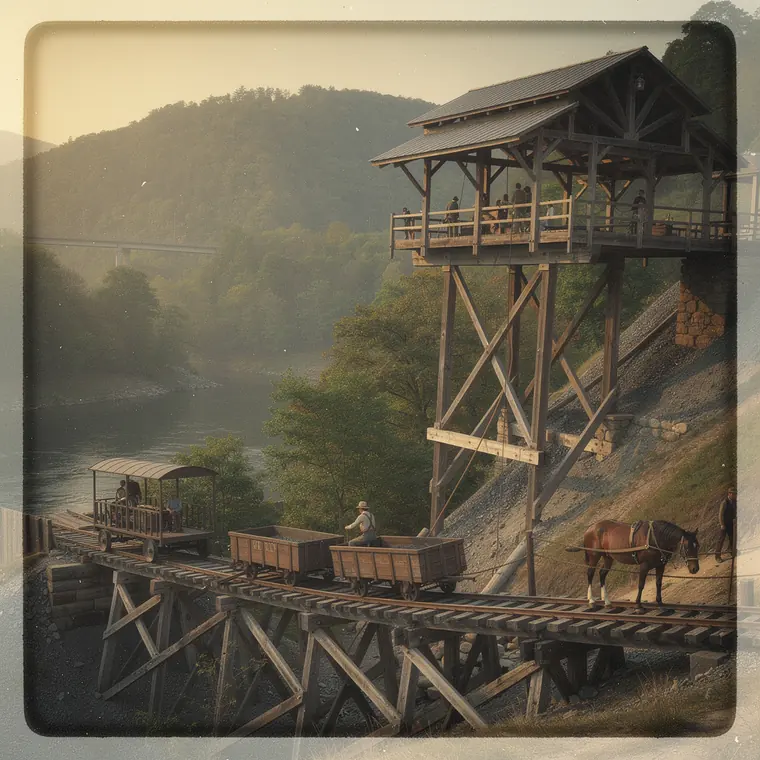
Loaded coal cars running by gravity down the Mauch Chunk Switchback from Summit Hill to the Lehigh River: a string of small wooden coal wagons with a brakeman riding on them, the track laid on the timber trestle, mules riding in a following car on the trestle track, the wooded hillside dropping to the river.
- What it was used for
- The Lehigh Coal and Navigation Company built the nine-mile line in 1827 to bring anthracite from the mines at Summit Hill down to Mauch Chunk on the Lehigh canal; the National Canal Museum gives 5 May 1827 as the start of operation and a build time of only three months. The rails were timber faced with strap iron, the grade a steady 75 to 100 feet per mile, the total descent just under 1,000 feet. Loaded cars ran down in about thirty minutes; mules hauled them back in two and a half hours. From 1844 two cable-worked planes at Mount Pisgah and Mount Jefferson lifted the empty cars and the mules were dispensed with. The Switch Back Gravity Railroad Preservation Society dates that rebuilding to 1845.
- What was new
- Not America's first railroad. The ASCE recognises the Granite Railway at Quincy, incorporated in 1826, as the first commercial railway in the United States; the ranking behind the label "second railroad" depends entirely on what one counts, and the 1971 Pennsylvania Historical and Museum Commission marker makes no claim to rank at all. The National Canal Museum defines its own claim narrowly: the first American railroad longer than five miles to carry substantial heavy freight. The real break was frequency - several round trips a day instead of one - and cost per ton fell by a third. That success is what made the line redundant: by about 1872 the steam locomotive had taken over the coal. The gravity road ran on for six decades as a pleasure ride - 30,478 passengers in 1873 alone - closed in October 1933 and was sold for scrap in 1937.
Further reading
- ExplorePAhistory.com, Marker Switchback Railroad (Pennsylvania Historical & Museum Commission)
- National Canal Museum, America's First Railroad
- Switch Back Gravity Railroad Preservation Society, History of the Switch Back Gravity Railroad
- ASCE, Historic Civil Engineering Landmark: Granite Railway
- HMdb.org, Transkription des PHMC-Markers Switchback Railroad (aufgestellt 1971)