Seaham Harbour Coal Drops
1831 · Coal Hopper at the Quay · Work 358 of 1,871
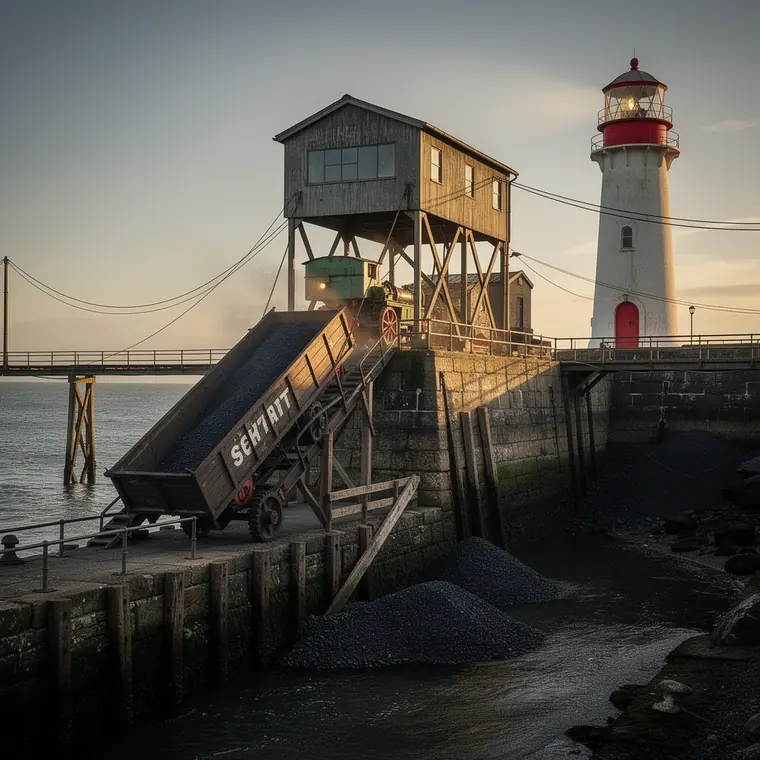
Chaldron wagons tipping coal down timber drops into a collier brig at Seaham Harbour on the Durham coast, the stone piers and lighthouse enclosing the loading basin.
- What it was used for
- The 3rd Marquess of Londonderry built his own harbour at Seaham for the coal of his collieries; he laid the foundation stone of the North Dock on 28 November 1828. On 25 July 1831, according to Seaham Town Council, the first coals ran down the new railway from the Rainton pits and were loaded into the brig Lord Seaham; guns, the Rainton band and 7,000 cheering spectators saw her sail. The drop lowered the loaded chaldron wagon of some two and a half tons in a cradle into the ship's hold, checked by a large wheel with a band brake, and raised the empty wagon back to the rails by counterweight. Durham Records Online puts the cost of the Rainton feeder railway at 20,000 pounds, of which 6,336 pounds went on wagons alone.
- What was new
- What was new was not loading from wagons but lowering instead of pouring: the coal did not fall down a spout, it rode into the hold in the wagon. That spared the large coal, whose breakage cut the price. Who introduced the method at Seaham is not documented. Beamish Museum states that William Chapman, engineer to the Londonderrys from 1820, patented a method of putting coal on board so as to prevent breakage in 1807 and, with John Buddle, possibly initiated the construction of the forerunner of these drops; it gives no patent number, and Grace's Guide does not list that patent. Drops already existed on the Tyne by then; for Seaham itself, a text of the 1830s reproduced by East Durham History describes loading by spout because of the height of the cliffs. The barb is in the trade: in the London measure, broken coal measured more than large. Anyone selling by measure profited from the very breakage the drops were built to prevent.
Further reading
- Seaham Town Council, Seaham Harbour 1828-1851
- Durham Records Online Library, Colliery Railways: Rainton and Seaham Railway 1831-1988
- Beamish Transport Online (Beamish Museum), Seaham Harbour
- East Durham History, Shipping Coal (reproduziert einen Text des 19. Jahrhunderts; Fallhöhe, Wagenlast, Londoner Volumenmaß)
- Grace's Guide, William Chapman (1749-1832) - Gegenprobe, führt das Patent von 1807 nicht