Dunston Staiths
1893 · Timber Loading Bridge · Work 359 of 1,871
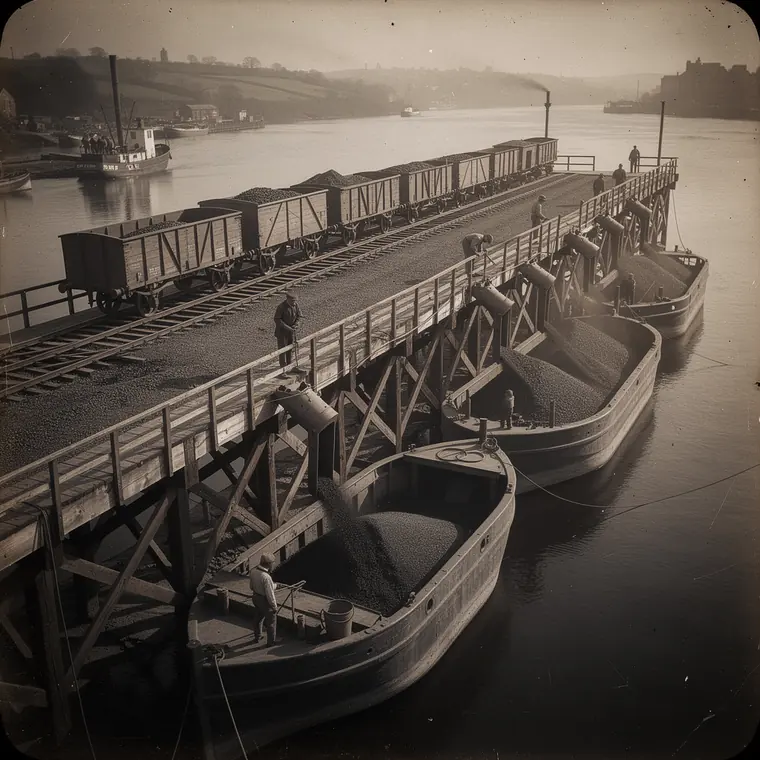
The timber staiths at Dunston on the River Tyne, a long trestle jetty of braced pitch pine timber carrying four rail tracks high over the water on an upper and a lower deck, loaded coal wagons standing upright on the rails on top of the staith, colliers moored alongside at the berths below, the coal chutes reaching from the deck down into the open holds of the moored ships, every chute ending inside a ship's hold, teemers working the chutes.
- What it was used for
- The North Eastern Railway built the staiths at Gateshead far out into the Tyne so that Durham coal could go straight into sea-going ships without transfer to keels. Construction began in 1890; the first loading was on 26 October 1893, the steamer Holmside. Historic England gives a length of over 1,700 feet, the Tyne and Wear Building Preservation Trust 526 metres, over 3,200 tons of North American pitch pine and a cost of 210,000 pounds. Four tracks on two levels served six berths; 98 braced frames at about 5.3 metre centres carry the deck. In 1894, the first full year, the Trust records 1,288,668 tons of coal shipped. Working ceased in 1977 and the staiths closed in 1980.
- What was new
- What was new was not the principle but the scale and the simultaneity: six ships at one structure instead of one at a drop, and a position in deep water. Historic England calls Dunston the last operating jetty staiths on the Tyne, and Newcastle's historic environment record the last working timber staiths. The widely repeated claim that this is the largest timber structure in Europe goes back to a Tyne and Wear Building Preservation Trust statement quoted by Co-Curate at Newcastle University, and even there the structure is only "believed" to be so; it appears in neither of the two Historic England entries consulted. For the peak, the same Trust statement gives 5.5 million tons a year without naming a year; the Trust's own page puts the peak in the 1930s. The structure outlived the coal. What destroys it now is arson - most recently in May 2020, after a further fire in 2019.
Further reading
- Historic England, River Tyne Dunston Coal Staithes, Listed Building 1248994 (Grade II, gelistet 13.01.1983)
- Tyne and Wear Building Preservation Trust, Dunston Staiths
- Newcastle City Council, Historic Environment Record / Sitelines, Dunston Staiths (SMR 1001)
- Historic England, Protecting Gateshead's Industrial Scheduled Monument: Dunston Staiths (Brand Mai 2020, Nothilfe)
- Co-Curate (Newcastle University), Dunston Staiths