Ruhraak bei Ruhrort
1780 · Ruhr Flat Bottomed Barge · Work 360 of 1,871
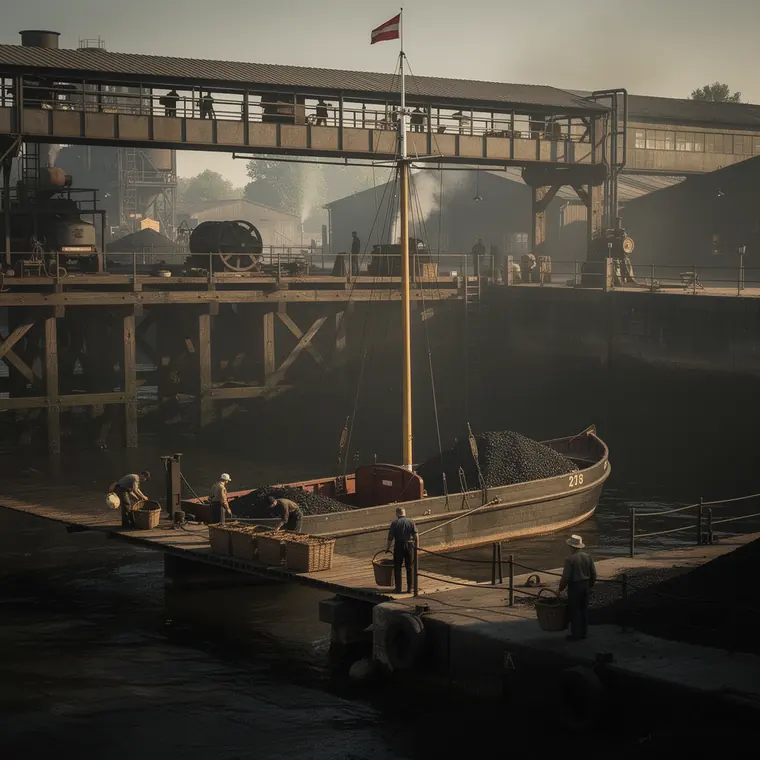
A flat-bottomed Ruhr aak moored at the coal wharf of Ruhrort, its single mast lowered for the lock, men carrying baskets of coal aboard on a plank gangway.
- What it was used for
- Between 1776 and 1780 the Ruhr was made navigable over 120 kilometres from Langschede to Ruhrort, with 16 locks; the Preussen im Rheinland portal gives 9 August 1780 as the day the locks were brought into use and names the military engineer Johann Friedrich von Schoeler as author of the tender documents for the locks. On that water ran the Aak, a flat-bottomed freight boat. Uwe Schnall describes the typical Ruhr boat, which he calls a "Ruhrnachen", in the Deutsches Schiffahrtsarchiv from a drawing of 1840: 33.3 metres long, 4.95 metres in the beam, capacity 1,900 to 2,000 hundredweight of coal, a crew of three or four, one mast, two leeboards. Two or three horses towed it upstream; Ruhrort to Witten took three days at best; the round trip up and down usually took six or seven days, chiefly because of the many locks.
- What was new
- What was new was not the boat but the river: coal from the coalfield now reached the Rhine without transhipment, and the Dutch markets faster. A single Aak carried what would otherwise have taken hundreds of cart loads - on the Sellerbeck horse tramway at Mülheim a coal wagon held seven hundredweight. The institutional sources consulted give no "Ruhr navigation edict" with a date of issue; what is documented is the works of 1776 to 1780 and the locks entering service on 9 August 1780. The end came quickly. Axel Heimsoth gives 868,000 tons of coal on the Ruhr in 1860 - on his account the busiest waterway in Europe - and the LWL portal confirms the same figure. For 1876 he gives just under 100,000 tons, and for 1889 some 74,700 tons against 25.6 million tons on the railway. The port of Ruhrort, by contrast, rose on Heimsoth's account to become Europe's largest inland port.
Further reading
- Uwe Schnall, Zeichnung der zur Beschiffung der Ruhr gebräuchlichen Nachen (1840), Deutsches Schiffahrtsarchiv 2 (1978), S. 25-27
- Axel Heimsoth, Steinkohle als Faktor der europäischen Infrastruktur, Der Anschnitt 71 (2019), H. 4, S. 168-179 (Deutsches Bergbau-Museum Bochum)
- Portal Preussen im Rheinland (LVR / Universität Bonn), Schiffbarmachung der Ruhr
- LWL, Internet-Portal Westfälische Geschichte, 1780: Schiffbarmachung der Ruhr
- Stadt Mülheim an der Ruhr, Kohlentransport und Ruhrkohlenschifffahrt (sieben Zentner je Kohlenwagen)