The Iron Moulder
1860 · Moulding Shop · Work 362 of 1,871
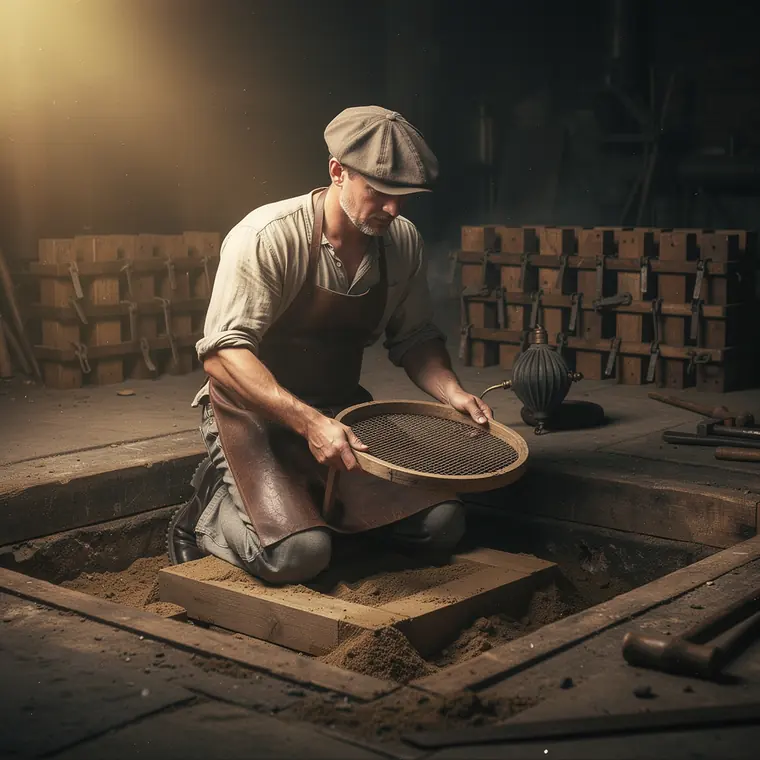
A foundry moulder ramming moulding sand around a wooden pattern in a floor pit, the man in a collarless shirt with rolled sleeves, a leather apron, heavy cloth trousers and hobnailed boots, a cloth cap, beside his knee a hand riddle that is a shallow round wooden hoop with a wire mesh bottom like a flat sieve, held in both hands to sift sand, a hand bellows for blowing loose sand, rows of clamped flasks waiting for the pour.
- What it was used for
- The moulder bedded the wooden pattern in green sand, rammed the sand, drew the pattern, set the core, closed the flask and poured iron from the cupola; then came knock-out and fettling. The work was paid by the piece: according to Craig Heron, by the 1890s nine-tenths of North America's stove-plate moulders were reputedly on piecework, and few of them made the castings for an entire stove. The Bureau of Labor Statistics gives average 1860 day rates from $1.57 in Connecticut to $1.87 in Maryland on a sixty-hour week; Illinois reports $3.00 with no hours given. Britain's Health and Safety Executive still lists foundry sands, fettlings and kiln linings as sources of silica dust: silicosis, lung cancer, COPD.
- What was new
- Nothing about hand moulding was new in 1860; green sand, core and flask are centuries older, and power-driven moulding machines were only tried from the late 1880s. Two things were new: the scale, because cheap cast iron turned the casting into a mass component, and the organisation. On 5 July 1859 the moulders held their first national convention at Philadelphia, and in January 1860 at Albany they formally agreed to form the National Union of Iron Molders; by 1866 its successor had 137 local unions and just under 10,000 members, said to be about nine-tenths of all journeymen iron moulders in the United States. In Britain the trade had been organised for fifty years by then: the Friendly Iron Moulders' Society dates from 1809. The skill all of it rested on could not be written down - mechanisation took another quarter century to begin.
Further reading
- U.S. Bureau of Labor Statistics, Bulletin No. 499, History of Wages in the United States from Colonial Times to 1928, Tab. I-31 (Molders, iron, 1843-1900)
- Craig Heron, The Crisis of the Craftsman: Hamilton's Metal Workers in the Early Twentieth Century, Labour/Le Travailleur 6 (1980)
- St. James Encyclopedia of Labor History Worldwide, National Union of Iron Molders (Konvent Philadelphia 5.7.1859, Gründung Albany Januar 1860; 1866: 137 Locals, ~10.000 Mitglieder)
- Archives Hub, Bestand Friendly Society of Iron Founders (Gründung 1809 als Friendly Iron Moulders' Society)
- Health and Safety Executive, COSHH essentials for foundries - FD0 (Quarzstaub, Silikose, Lungenkrebs, COPD)
- Modern Records Centre, University of Warwick, Friendly Society of Iron Founders of England, Ireland and Wales (FSIF), 1809-1961