The Riveting Gang
1890 · Riveting Gang · Work 363 of 1,871
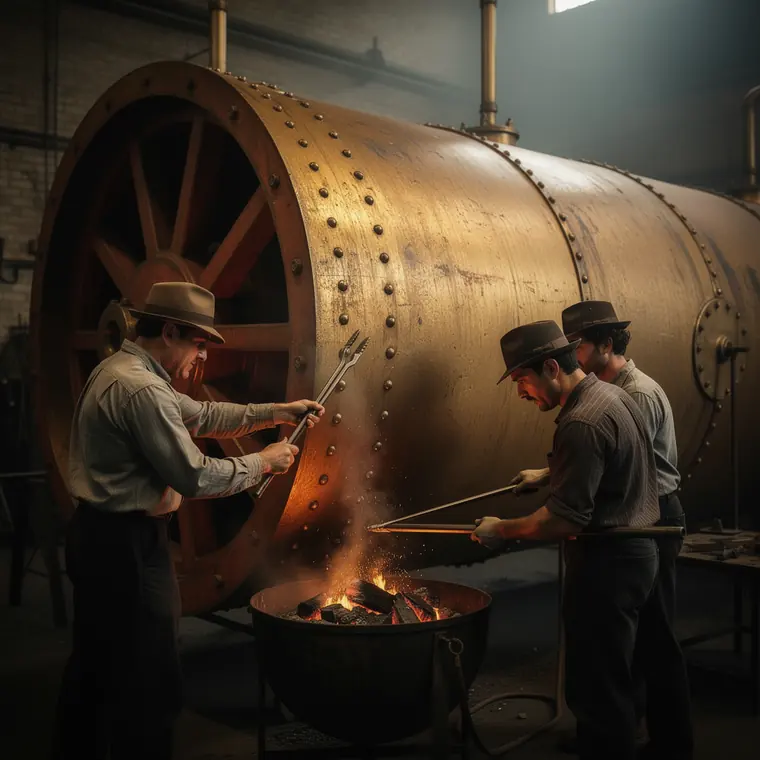
A four-man riveting gang on a boiler shell, heater lifting a rivet from a coke brazier with tongs while the holder-up braces a dolly inside the drum.
- What it was used for
- The gang joined steel plate where in 1890 there was no alternative: a heater, a holder-on and one or two riveters. The heater kept the fire and passed the glowing rivet; the holder-on backed it from behind and the riveters closed the head. Payment went to the gang, not the man: the U.S. Bureau of Labor Statistics recorded in 1921 that the proceeds had to be divided among the riveters, the holders-on and the heaters, on piece rates per rivet. The Forth Bridge, finished in November 1889 and opened on 4 March 1890, contains 6.5 million rivets weighing 4,200 tons according to Network Rail; the ASCE gives eight million.
- What was new
- What was new was not riveting but the material, and with it the scale: the Forth Bridge was, according to Network Rail, the first major structure in Britain to be made of steel, and according to ASCE it held the world record span for 27 years. The machines were not new either. Ralph Hart Tweddell designed a stationary hydraulic riveter in 1865 and a portable one in 1871; the obituaries of the engineering institutions put the cost at about one-seventh of hand work. Yet on Wilhelm Westhofen's account only about half the riveting on the Forth Bridge was done by hydraulic machines, the rest by hand; the Titanic of 1911 was held together by roughly three million rivets, on the NIST figure. As welding displaced riveting from about 1932, Lt. M. G. Vangeli still calculated in the U.S. Naval Institute Proceedings of 1937 that a riveting gang turned out about double the daily footage of a welder. He was right, and he lost.
Further reading
- Network Rail, The history of the Forth Bridge, Fife (6,5 Mio. Niete, 4.200 t, 53.000 t Stahl, 4.600 Mann)
- ASCE, Historic Landmark Firth of Forth Railway Bridge (abweichend: acht Millionen Niete)
- U.S. Bureau of Labor Statistics, Bulletin No. 283, History of the Shipbuilding Labor Adjustment Board, 1917 to 1919, GPO 1921
- Grace's Guide, Ralph Hart Tweddell (1865 stationäre, 1871 tragbare hydraulische Nietmaschine; ein Siebtel der Kosten)
- M. G. Vangeli, Welding Versus Riveting in New Construction, U.S. Naval Institute Proceedings 63/2/408, Februar 1937
- NIST, Science Showed How a Tiny Iron Flaw Doomed the Titanic (rund 3 Millionen Schmiedeeisen-Niete)
- Wilhelm Westhofen, The Forth Bridge (Engineering, 1890), Abschnitt Rivetting (Transkription Wikisource)