The Stoker
1885 · Boiler House · Work 364 of 1,871
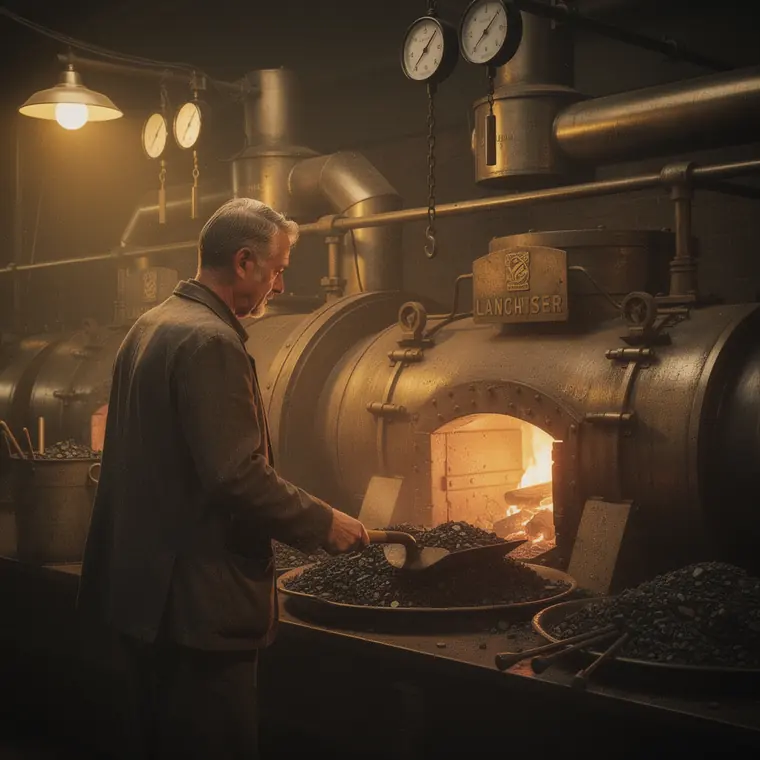
A stoker feeding a bank of Lancashire boilers, shovel angled into the firehole, coal heaped on the plates behind him, water gauges and a whistle chain overhead.
- What it was used for
- Two trades shared the stokehold: the trimmer fetched coal from the bunkers and barrowed it to the boiler room, the fireman fed it to the furnaces. Work ran in three watches, four hours on and eight off. The quantities grew with the ships: a 1902 Cunard brochure, reprinting an article from Business Illustrated, gives 38 tons of coal a day for the Britannia of 1840, 90 for the Russia of 1867 and 190 for the Servia of 1881. The chapter "The Stoker" in Old Ocean's Ferry describes the conditions in 1900 as 120 to 160 degrees Fahrenheit, four furnaces to a man, and claims the heat had at times driven stokers temporarily insane - a contemporary account, not a measurement.
- What was new
- Nothing about the trade was new in 1885. What was new was everything around it: higher boiler pressures, triple-expansion engines, later forced draught - the same shovel, more coal per hour. Ashore the hand work was replaced earlier than at sea, and there too more than one man was at it: Edward Bennis developed a mechanical stoker from 1870 and patented one in 1875, while James Proctor held a patent by 1887 at the latest; the two fought over it in court in the 1880s. In June 1911 the Olympic's crew walked off the ship, bringing the national seamen's strike forward, and the engine-room crew won ten shillings a month more. Nine years later the same ship was converted to oil firing. The wage they had won survived; the job did not.
Further reading
- The Story of the Cunard Line, Nachdruck aus Business Illustrated, Dezember 1902, hg. von Cunard (GG Archives) - Kohleverbrauch Britannia, Russia, Scotia, Servia
- Kapitel The Stoker, in: Old Ocean's Ferry, New York: Bonnell, Silver & Co., 1900, S. 121 (Transkription, GG Archives)
- Encyclopedia Titanica, Trimmer und Fireman (nach Guenter Baebler, Guide to the Crew of Titanic, 2017) - Wachsystem, Aufgabenteilung
- Grace's Guide, Bennis Combustion (Entwicklung ab 1870, Patent 1875, Gründung 1879)
- Grace's Guide, James Proctor (Patent auf mechanischen Rost spätestens 1887, Patentprozess)
- The Strike and the Split - The NSFU and BSU in Southampton, 1911-1913 (academia.edu) - Olympic-Besatzung 10.6.1911, zehn Shilling je Monat für die Maschinenraumbesatzung
- Encyclopedia Titanica, News from 1920: Olympic of the Oil Age (Zeitungstranskription; Umbau der 195 Feuer auf Ölfeuerung)