The Smith and Striker
1840 · Forge · Work 366 of 1,871
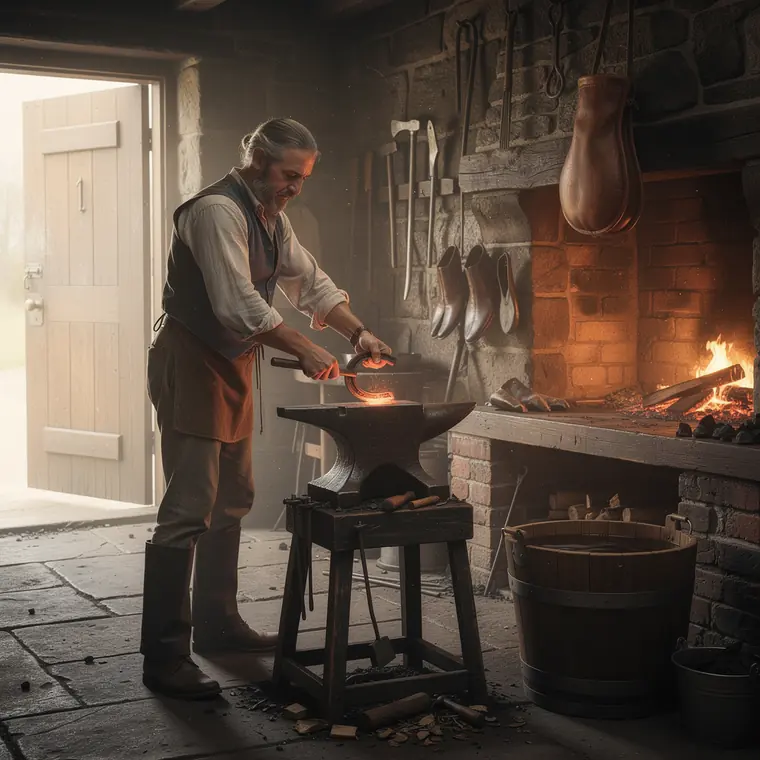
A smith and his striker working a horseshoe on the anvil in alternating blows, hardy and swage tools ranged on the block, hoof parings swept against the wall, the smith in a leather apron over a collarless linen shirt with rolled sleeves, the striker in a waistcoat and shirt, both bare-headed or in soft cloth caps, a wooden water tub and an iron slack bucket beside the hearth, the forge lit by the coal fire and daylight from the open door, stone walls and a brick hearth with leather bellows.
- What it was used for
- The smith held and guided, the striker struck. For the heaviest chain, a National Park Service study of the chain forge at the Boston Navy Yard records that a smith and two strikers worked together to close a link brought to welding heat. What they made was horseshoes, tools, fittings, chain, anchors. How many men stood at a hand-forged anchor in the 1840s is not documented. The U.S. census counted 10,373 blacksmith shops in 1850 and 7,504 in 1860; the series is distorted by changes in the way the census was taken, and by about 1900 the Census of Manufactures no longer listed blacksmithing as a separate industry.
- What was new
- What was new was the steam hammer, and not because it struck harder but because the blow could be controlled: a drop hammer could only fall. James Nasmyth sketched it on 24 November 1839, prompted by the paddle shaft of the Great Britain; his British patent No. 9382 is dated 9 June 1842, the American one 1846. He was not first with it: Schneider at Le Creusot held the French patent from 19 April 1842 - because, on the Dictionary of National Biography's account, a visitor had seen the drawings in Nasmyth's own works in 1840. The Smithsonian notes that Nasmyth was not the first but that his design revolutionised the manner and speed of iron forging. For the hand smith it meant the work moved under the machine, but slowly: at the Boston chain forge the closing weld was still made by hand in 1910.
Further reading
- Dictionary of National Biography 1885-1900, Nasmyth, James (Skizze 24.11.1839; GB-Patent Nr. 9382 vom 9.6.1842; Schneider FR-Patent 19.4.1842)
- Smithsonian, National Museum of American History, Nasmyth Steam Hammer (US-Patent 1846; nicht der Erste; Zweck Schaufelradwelle Great Britain)
- National Park Service, Special Resource Study: Chain Forge Machinery in Building 105, Boston Navy Yard (ein Schmied und zwei Zuschläger; Mechanisierung 1910-1914)
- Jeremy Atack / Robert A. Margo, Gallman Revisited: Blacksmithing and American Manufacturing, 1850-1880 (US-Zensus 1850 und 1860)