The Chainmakers
1890 · Chain Forge · Work 367 of 1,871
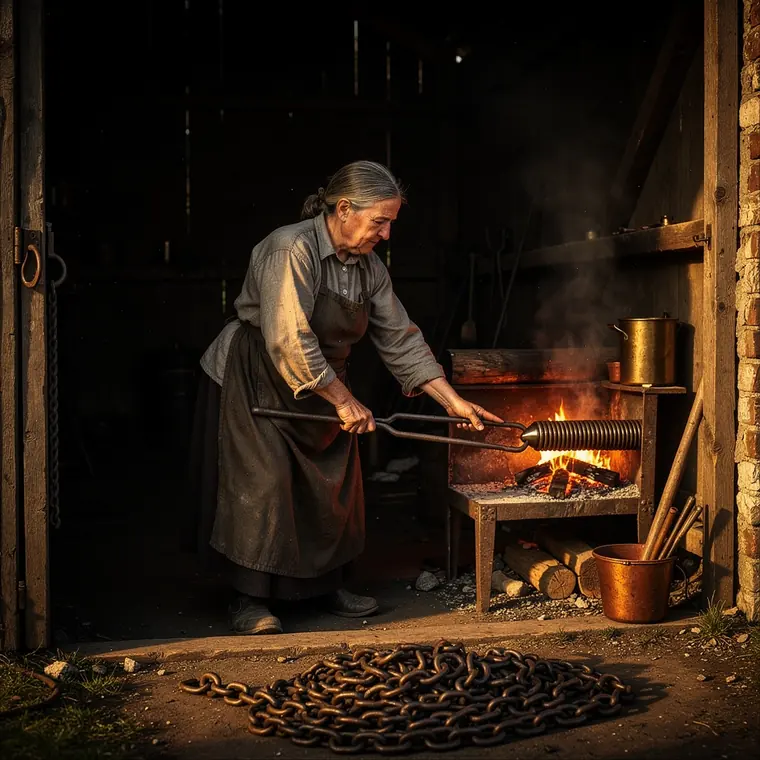
A woman chainmaker at a small hearth bending a heated link around a mandrel with tongs, finished chain coiled on the earth floor of an open-fronted shed.
- What it was used for
- Small chain was hammered by hand in the Black Country, in backyard forges and as outwork for chain firms and middlemen; heavy chain and ships' cable were made by men in factories. Unite the Union gives 2,103 women chainmakers in Staffordshire and Worcestershire for 1911, nearly 2,000 chainmakers of both sexes in Cradley Heath, and 918 of 938 small-chain workshops in that area. The same source gives 4s to 5s a week for 12 to 13 hour days, hammering up to 5,000 links a week, and alongside it a second range of 4s to 6s for a 50 to 58 hour week, so the figure is already unsettled within the source. The Chain Trade Board rate of twopence-halfpenny an hour was, according to the Modern Records Centre at the University of Warwick, nearly double existing pay for many of the women.
- What was new
- What was new was not the chain but a wage floor fixed by the state in a trade with no collective bargaining: before it, the buyer alone set the piece rate. It was not a world first; an IZA working paper calls Victoria's Factories and Shops Act 1896 the second minimum wage law in the world, after an 1894 New Zealand law. The dates are of different kinds: 1909 is the year of the Trade Boards Act, while the twopence-halfpenny was a 1910 decision of the Chain Trade Board. The barb sits in the Act itself: Unite describes a postponement to 17 August 1910 and a right to contract out for a further six months, after which employers collected signatures and from 23 August withheld iron from the workshops. Technically it was electric resistance welding that displaced the hand: W. H. Hodges claims, in US 1,072,614 (filed 9 June 1908, granted 9 September 1913), the welding of chain links by delayed current heating with graduated endwise pressure.
Further reading
- Modern Records Centre, University of Warwick: The women chainmakers of Cradley Heath
- Unite the Union: Women Chainmakers - Be Anvil Or Hammer! (PDF)
- US-Patent 1.072.614, W. H. Hodges, Method of electrically welding chain-links (erteilt 1913)
- US-Patent 347.140, Elihu Thomson, Apparatus for Electric Welding (1886) - nennt Kettenglieder nicht
- IZA Discussion Paper 16788: The Factories and Shops Act of Victoria (Australia), 1896