The Weaving Shed
1835 · Weaving Mill · Work 368 of 1,871
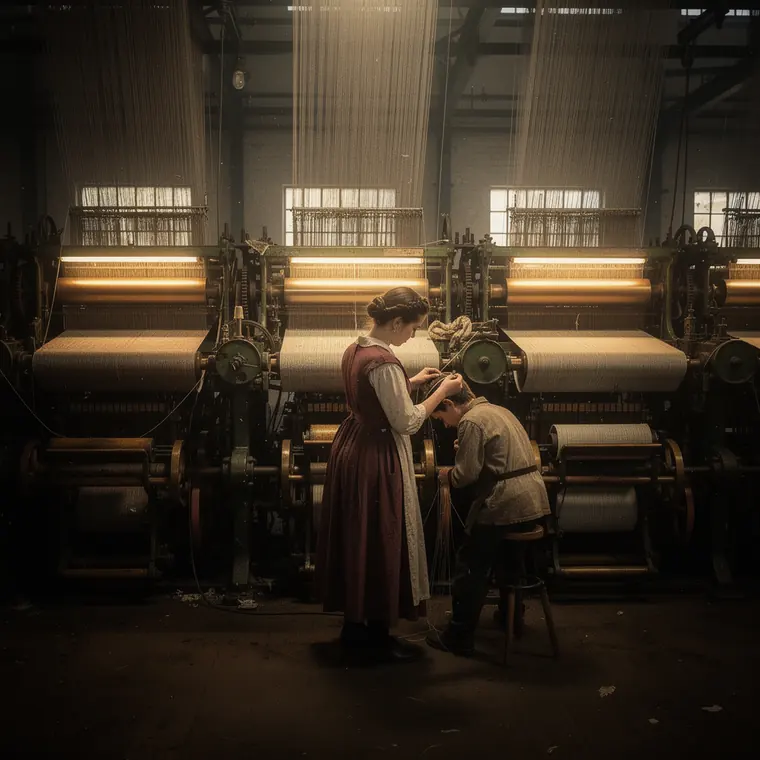
A woman weaver tending four power looms in a mill shed, shuttle boxes and taut warp threads, a young piecer leaning in to join a broken end.
- What it was used for
- The weaving shed was the single-storey hall that held the power looms, standing beside the multi-storey spinning mills of east Lancashire. Pendle Borough Council's weaving shed study explains the north-light roof by the need for evenly distributed light across the whole floor area, because shadows could disguise faults in the cloth; the same study dates the building type to the mid-1800s, so 1835 catches it at the start. Robert Allen's table gives 108,894 power looms in Britain for 1835, after Baines, Timmins and Wood, alongside 188,000 handloom weavers, after Wood. Lancashire County Council states that its museum mill, Queen Street Mill in Burnley, held over 900 looms; at one weaver to four looms that needed over 200 weavers. A report on that museum records that widespread deafness produced the workforce's sign language, mee-mawing, with exaggerated mouth movements.
- What was new
- What was new was neither the factory nor the power loom but the building form: a roof that spread glare-free north light evenly over a very large floor area on one level, so looms could stand in rows by the hundred and faults in the cloth stayed visible. The Pendle report does not say who built the type first; it describes it only as a new building type of the mid-1800s. The barb sits in the same room: weaving, the report says, favoured damp internal conditions, so the hall had to be kept warm and damp, good for the thread, bad for the workers' health. Regulation came 54 years later: according to the 1911 Encyclopaedia Britannica, the Cotton Cloth Factories Act 1889 required notice to the chief inspector before humidity was produced artificially, and fixed a minimum of 600 cubic feet of fresh air per person per hour.
Further reading
- Pendle Borough Council: Northern Lights - Pennine Lancashire Weaving Shed Study (PDF)
- Lancashire County Council Museums, 50 Objects: Weaver's Tools (Archivfassung 11.4.2026)
- Encyclopaedia Britannica, 11. Aufl. (1911), Bd. 16, S. 26, Labour Legislation - Cotton Cloth Factories Act 1889 (Transkription des Originaldrucks)
- Robert C. Allen: The Hand-Loom Weaver and the Power Loom, NYU Abu Dhabi Working Paper 0004 (2017), Tab. 1
- Great British Life: Textile heritage at Burnley's Queen Street Mill (Taubheit, mee-mawing)