The Mule Spinner
1850 · Spinning Mill · Work 369 of 1,871
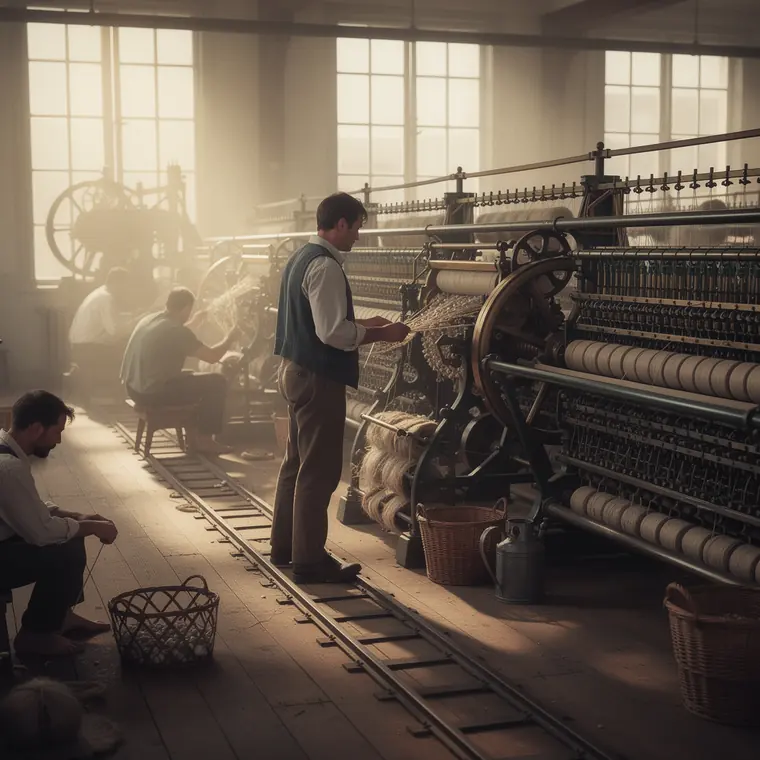
A mule spinner walking the carriage back along its rails in a spinning room, the carriage a low iron frame running on small iron wheels on flat rails set flush into the wooden floorboards, hundreds of spindles along the carriage drawing yarn from the rovings on the creel behind, bobbin baskets and an oil can beside the headstock, the spinner and barefoot piecers in shirtsleeves, the room lit by daylight through tall windows only.
- What it was used for
- The mule spinner, in the trade the self-actor minder, worked self-acting mules in a Lancashire spinning mill and spun cotton yarn. Pay followed his district's wage lists: the employer paid the team a lump sum, which the spinner divided between himself and his two assistants, the piecer and the little piecer. The Science and Industry Museum in Manchester describes the spinning room as hot, humid and deafeningly noisy, and records that children had to mend threads and sweep among fast-moving machines. The spindles ran in oil: in 1928 S. A. Henry set out, in the Journal of Hygiene, 300 cases of mule spinners' cancer of the scrotum recorded between 1920 and 9 February 1928, most often after 35 to 39 years of contact; the earliest case he could find on record dates from 1887. Mineral oil, Henry writes, was first introduced as a lubricant about 1850; the mineral oils gradually introduced after 1862 were later proved carcinogenic.
- What was new
- What was new about the self-acting mule was not the spinning but that the carriage's inward run and the winding-on went without the spinner's hand. A contemporary newspaper report reprinted by Grace's Guide describes Roberts' 1825 patent as confined to the headstock; the rollers, spindles and body of the mule were left unaltered. The same source states as the machine's capability that the tension of the yarn in winding on is always the same, on a bare spindle as on a full cop. 1825 and 1830 are two separate patents; according to the newspaper report of 17 November 1825 the first had already been granted, while for the second Grace's Guide gives only the year. The barb: developing the improved 1830 version cost 12,000 pounds, per Grace's Guide, and Sharp, Roberts & Co. had recovered only 7,000 pounds of profit from it by 1839 - the machine prevailed, its builder had not recovered his costs by 1839.
Further reading
- Grace's Guide: Richard Roberts - Self-acting Spinning Mule (Patent 1825 auf den headstock beschränkt; 12.000 Pfund Entwicklung, 7.000 Pfund Gewinn bis 1839)
- S. A. Henry: Mule Spinners' Cancer - the Time necessary for its Production, Journal of Hygiene (1928), PDF bei Cambridge Core
- Archives Hub / John Rylands Library: Archive of the Amalgamated Association of Operative Cotton Spinners, GB133-ACS
- Science and Industry Museum Manchester: Textiles Gallery, Large-print book (Spinnsaal, Kinderarbeit an laufenden Maschinen)
- Wellcome Collection: Henry Butlin, On cancer of the scrotum in chimney-sweeps and others, London 1892 (Nachdruck aus dem British Medical Journal, Juni/Juli 1892)
- The National Archives Discovery: Archives of the Amalgamated Association of Operative Cotton Spinners and Twiners (ACS, University of Manchester Library)