The Compositor
1875 · Composing Room · Work 370 of 1,871
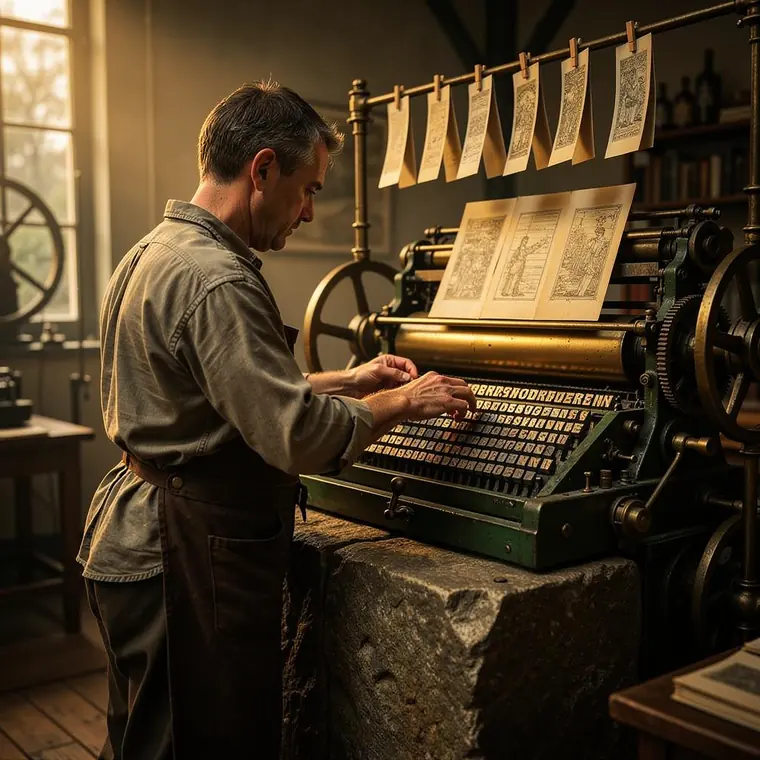
A compositor standing at a type case with a composing stick in hand, picking sorts letter by letter, galley proofs pegged on a line above the imposing stone.
- What it was used for
- The hand compositor lifted single pieces of lead type from the case, letter by letter into the composing stick, slid the lines onto the galley and, after printing, distributed the type back into the case; in newspaper offices this was night work against the press deadline. The trade publication Collation of Facts Related to Fast Typesetting (1887) reports for 1847 that 1,200 ems an hour was deemed a fairly quick hand, 1,400 fast, 1,700 wonderful and 2,000 among the physical impossibilities; by 1887 at least seven compositors had passed 2,000 ems an hour in public contests. The Museum Industriekultur in Nuremberg gives about 1,400 characters an hour for a practised hand compositor, a different measure from ems. Not a healthy trade: in All the Year Round, 1864, cited by Daskalova, consumption was twice as common among London printers as among the general male population of London.
- What was new
- Hand composition itself held nothing new in 1875; the International Printing Museum records that until the Linotype, type was set and distributed by hand as it had been since Gutenberg. What was new is what displaced it, and not as the first composing machine: several existed before, and Mergenthaler himself, per the Printing Museum, abandoned earlier designs of 1877, 1878 and 1884. The Linotype cast whole lines afresh from matrices, so the distribution of single types, which the museum names as the second half of the handwork, fell away. The German Historical Institute gives 12 May 1885 as the grant date of patent No. 317,828 for the single-matrix machine; in 1886 the New York Tribune put the first machine into daily production. The barb: Scientific American calculated on 9 March 1889 that the Tribune's thirty Linotypes, running eight hours a day, did work that would have needed about ninety men the old way.
Further reading
- Collation of Facts Related to Fast Typesetting (1887), zitiert in HistoryofInformation.com: Speed Contests of Manual Typesetters
- Museum Industriekultur Nürnberg: Schaustück des Monats Juli 2015 - Die Linotype-Setzmaschine
- Immigrant Entrepreneurship (German Historical Institute): Ottmar Mergenthaler (Patent Nr. 317.828 erteilt 12.05.1885; Scientific American, 09.03.1889)
- International Printing Museum: 1895 Linotype (aufgegebene Vorgängerbauten 1877, 1878, 1884; erste Maschine bei der New York Tribune 1886)
- Modern Records Centre, University of Warwick: London Society of Compositors
- Daskalova: Work and health in the nineteenth-century printing office and asylum (2021), Strathprints