The Wheelwright's Tyre
1820 · Wheelwright's Shop · Work 371 of 1,871
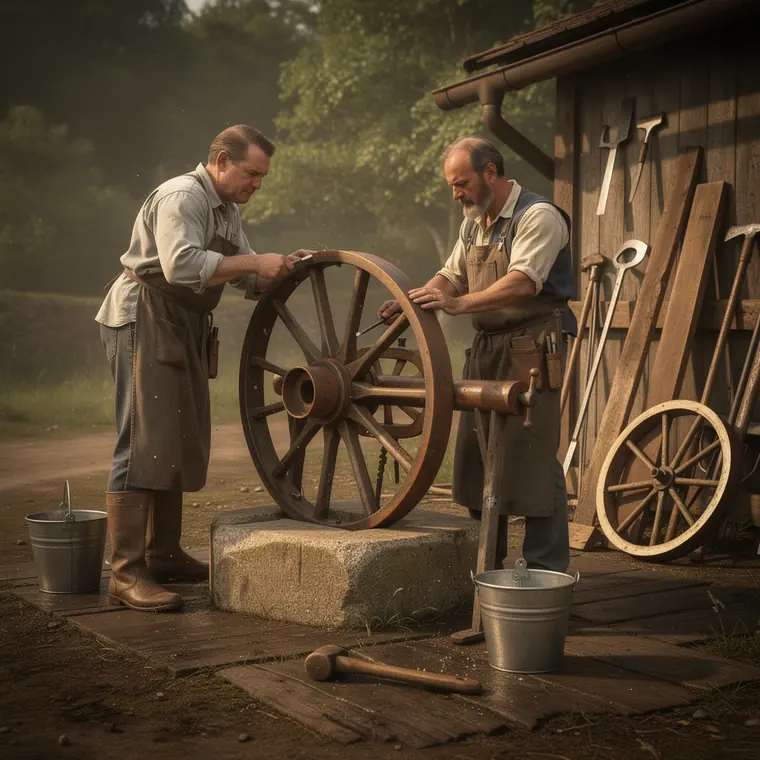
A wheelwright and his apprentice shrinking an iron tyre onto a cartwheel laid over a stone platform, buckets of water ready, spoke shaves and felloe blanks against the shed.
- What it was used for
- The iron tyre was the wearing part of a cart wheel and at the same time held felloes and spokes together. The work was done on a stone tyring platform with a hole for the hub: measure the bar, bend and weld it into a ring, toggle the wheel down, force the red-hot tyre on, quench at once with water - the sequence as described by the Donard/Imaal Historical Society. Often two trades shared the wheel: the wheelwright built it and, by the same source, a smith made and set the tyre. The Worshipful Company of Wheelwrights lists tyre-smiths as a separate trade, citing R. Campbell's The London Tradesman (1747), at 22 shillings a week for a journeyman against 12 to 15 for a cart-wheeler's journeyman. Robin Wood, reporting on the working wheelwright Phill Gregson, writes that the tyre is made slightly smaller than the wheel's circumference - how much is a matter of experience, on Gregson's wheels one inch - and that the setting-on itself takes about two minutes.
- What was new
- The continuous tyre itself was not new. The Worshipful Company of Wheelwrights writes that one-piece tyres already existed in the Roman period; they disappeared and returned in the 18th century, by the same source reaching Britain in the last quarter of the 18th century - so the dating stays imprecise, and the same source says strake shoeing, with six separately nailed strips per wheel, continued into the later 19th century. What was new is what the shrunk ring could do: cooling, it pulled felloes and spokes together and set the wheel to the intended dish, instead of merely covering the joints between the felloes. The wheel now held by tension, though the tyre was still nailed to the rim. It needed the smith's fire; by Campbell, tyre-smiths were already a separate and better-paid trade in 1747, before the hoop tyre reached Britain.
Further reading
- The Worshipful Company of Wheelwrights - Ancient Craft (römische einteilige Reifen; tyre-smiths als eigenes Gewerbe; Löhne nach Campbell, The London Tradesman, 1747)
- The Worshipful Company of Wheelwrights - Making A Wheel (sechs strakes je Rad; hoop tyres in Britannien im letzten Viertel des 18. Jahrhunderts; Schrumpfen stellt die Wölbung)
- Donard/Imaal Historical Society (Wicklow Heritage) - Tyring Platforms
- Robin Wood - Wheelright tyring a wheel (Stellmacher Phill Gregson: ein Zoll kürzer, rund zwei Minuten)
- Science Museum Group Collection - Tyre bending machine and combined drill by W. Affleck, Swindon, 1853-1891