The Cooper
1860 · Cooperage · Work 372 of 1,871
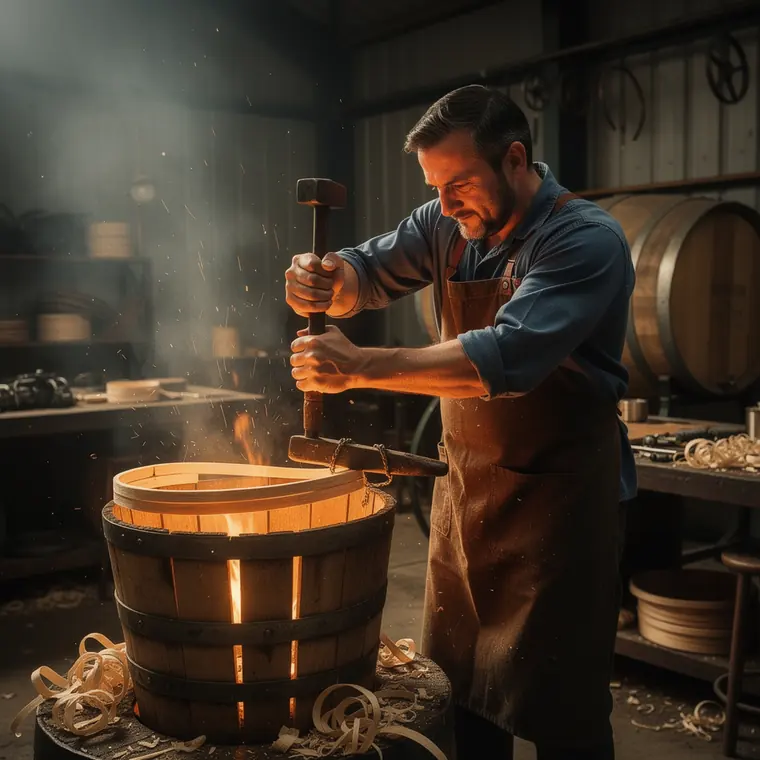
A cooper raising a barrel over a fire basket, driving hoops down the staves with hammer and driver, shavings curling around his bench in a workshop.
- What it was used for
- The cask was the general container for liquids and dry goods. For scale: the Scottish Fisheries Museum gives 2,500,000 barrels, or 250,000 tons, cured and exported at the 1907 peak of the herring boom. Heritage Crafts ranks the trade by skill: wet cooperage, for fluids sometimes under pressure, as the most skilled, white cooperage at village level for household utilities, dry cooperage as the least. In the brewery the cooper was the top earner: the Guinness Storehouse gives about 300 coopers at St James's Gate in the 1920s, roughly two and a half days of work per cask, an apprenticeship of five to seven years, and coopers as the highest paid tradesmen in the brewery. The same source states that every part of the cask was made by hand, without measuring devices and without adhesives, using over thirty different types of tool.
- What was new
- What was new around 1860 was not the cask but the breaking up of cask making into single-purpose machines, each replacing one of the cooper's hand operations. The historic-register nomination for the E. & B. Holmes Machinery Company building in Buffalo ('The Cooperage') gives, for the firm, incorporation in 1856, a patent for improved stave making machines in 1861, an improved crozing and chamfering machine in 1873, some forty different barrel machines by 1881, over 60 patents by 1888, and about 400 employees in the 1880s. A line of machines thus took over the curvature that had sat in the cooper's eye. The barb: in the end the metal cask displaced the wooden cask itself. The Guinness Storehouse gives 1946 for the introduction of aluminium kegs, and March 1963 for the last wooden cask filled at St James's Gate. Heritage Crafts today lists coopering other than for spirits (beer, cider, wine) as endangered and counts five full-time coopers, one part-time and one trainee.
Further reading
- Guinness Storehouse: St. James's Gate Cooperage
- Guinness Storehouse: A Day in the Life of a Guinness Cooper
- Scottish Fisheries Museum: The Herring Boom
- Heritage Crafts: Coopering (non-spirits)
- State and National Register of Historic Places Nomination: The E. & B. Holmes Machinery Company Building, „The Cooperage“, Buffalo (Dezember 2008, PDF)