The Ropewalk
1830 · Ropewalk · Work 374 of 1,871
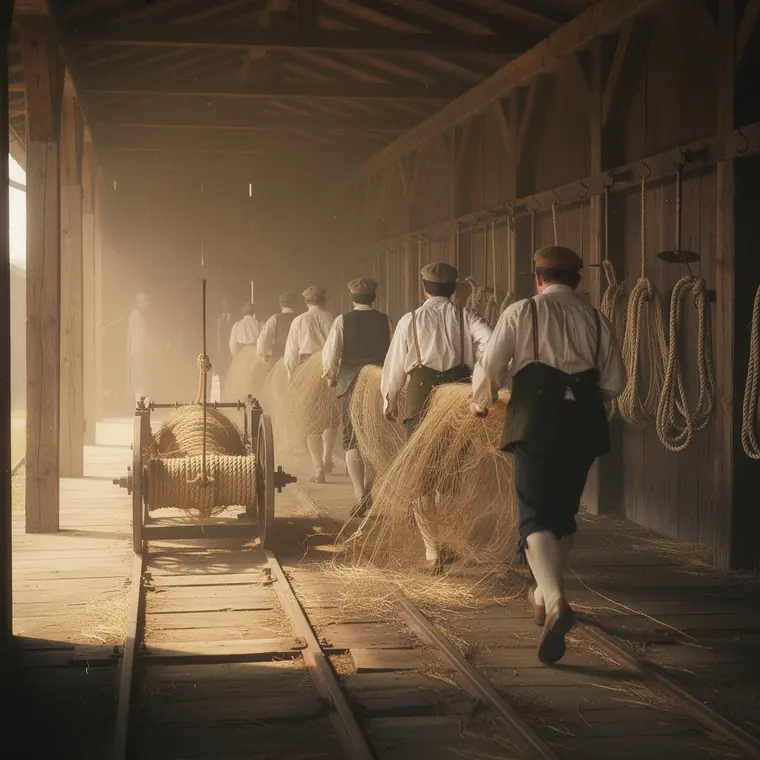
Rope makers walking backwards down a long covered ropewalk, each man walking away from the spinning wheel with his back to the far end of the walk, hemp yarn paying out from bundles at their waists, the twisting cart creeping along the rails behind, the men in linen shirts, waistcoats, breeches and cloth caps, the ropewalk a long low timber shed with a row of posts and hooks along its length and nothing but rope, hemp and the cart at its far end.
- What it was used for
- In the ropewalk hemp yarn was laid into strands and the strands closed into cordage; the length of the walk limited the length of the rope. Chatham's double ropery of 1785 to 1791 is, per its Grade I listing text, over 1,100 feet long, about 335 m: spinning on the two upper floors, laying on the ground floor, where the Maudslay forming machine and winches of 1811 still stand. The Naval Dockyards Society gives 1,265 ft for the building and 1,128 ft for the laying floor; the operator's visitor pages say a quarter of a mile and elsewhere over 1,100 ft. The Chatham Historic Dockyard Trust puts a first-rate's requirement at roughly 31 miles of rope, over 20 miles of it rigging; laying the largest 24-inch cable took 220 men according to the Naval Dockyards Society. Naval rope carried a coloured rogue's yarn in its lay as a theft mark - per the operator, yellow at Chatham, blue at Portsmouth, red at Plymouth.
- What was new
- What was new was not the machine but a measurement that had previously sat in the master's eye. Joseph Huddart's register plate - concentric circles of holes for the yarns, with a forcing tube behind - spread the tension evenly over all the yarns, so that the outer yarns, running the longer path, no longer failed first; Edward Sargent (Docklands History Group, 2015) calls the result twice as strong as conventionally laid rope, which is his figure. Kind and number: an English old-series patent of 1793, whose number the ropecord.com cordage bibliography gives as 1952, correcting Dickinson's misprint. Around 1800 (Sargent: c1800) Huddart installed two stranding machines at his Limehouse works; that is not a patent year. Huddart was not alone: John Daniel Belfour dated a patent specification for a rope-making machine 16 March 1793.
Further reading
- Kent Heritage, Grade-I-Listung: The Ropery and Spinning Room, Chatham (1785-91; über 1.100 Fuß; Maudslay-Formmaschine und Winden von 1811)
- Naval Dockyards Society - Chatham (1.265 Fuß Gebäude, 1.128 Fuß Legeboden; 220 Mann für das 24-Zoll-Kabel)
- Chatham Historic Dockyard Trust - Our buildings (Schiff erster Klasse: rund 31 Meilen Seil, über 20 Meilen Takelage)
- Chatham Historic Dockyard Trust - The Victorian Ropery (eigene Angabe quarter of a mile)
- Chatham Historic Dockyard Trust - Wally delves deeper (Königsgarn: Chatham gelb, Portsmouth blau, Plymouth rot)
- Edward Sargent, A History of Rope Making, Docklands History Group, März 2015 (Register-Platte 1793; doppelte Festigkeit; Limehouse um 1800)
- A Bibliography of Cordage and Cordage Making, ropecord.com (Huddarts Patent von 1793 ist Nr. 1952; Belfour-Patentschrift vom 16. März 1793)