The Footplate
1895 · Locomotive Cab · Work 375 of 1,871
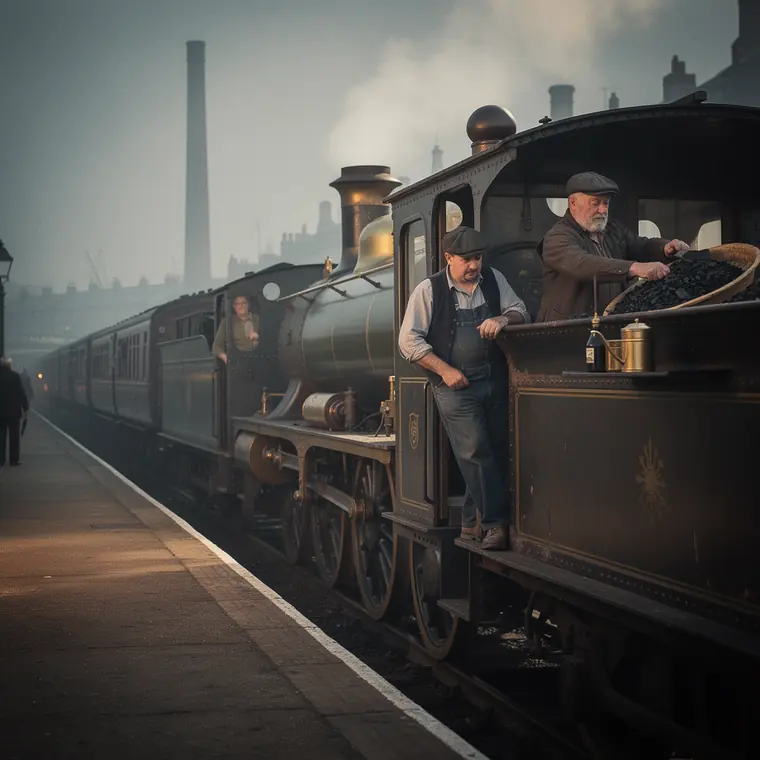
A driver and fireman on the footplate of a tender locomotive standing at a platform end, seen from the platform at the side of the cab: the open cab side with its cut-out, the driver leaning out over the cab side sheet with one hand on the rail and the fireman behind him shovelling coal from the tender into the firehole, the long boiler running forward from the cab towards the front of the engine and the chimney far ahead at the smokebox end, the tender coupled close behind the cab, steam drifting from the safety valves, an oil feeder and a tin tea can on the cab shelf, the men in overalls, waistcoats and greasetop caps.
- What it was used for
- The footplate was the workplace of two men with separate jobs: the driver handled regulator and reverser and was responsible for running the train safely and obeying signals; the fireman kept the engine in steam and, on steamlocomotives.org's account, shovelled several tons of coal on a long run. Promotion went strictly by seniority: cleaner, passed cleaner, fireman, passed fireman, driver, and the same source puts twenty years or more before regular driving turns. What the footplate was also used for in 1895 shows in August: on the night of the 22nd to the 23rd, LNWR engine 790 Hardwicke ran the 141 miles from Crewe to Carlisle in 126 minutes, about 67 miles an hour average. The glory went to the companies; in the Commons on 23 January 1891 Mr Channing cited 219,791 instances of drivers and firemen working over twelve hours and 7,341 of eighteen hours and over, both in September 1889 alone.
- What was new
- What was new was not the machine but the qualification. In the Mutual Improvement Classes senior drivers and inspectors taught rules, signalling and the workings of the locomotive voluntarily and usually unpaid; the men ran the classes themselves, with examinations and promotion ahead (steamlocomotives.org). Who held such classes first is not documented. Second, the form of representation was new: in February 1880 footplatemen founded a craft union of their own, ASLEF, because the older Amalgamated Society of Railway Servants did not take up their pay and hours grievances (Trade Union Ancestors). According to ASLEF the first registered lodge was formed in Sheffield on 7 February 1880; within a year the union's head office was at Holbeck, Leeds, as ASLEF and Trade Union Ancestors both state. Success came late: ASLEF dates a mostly achieved ten-hour day only to 1904, except in Scotland and Ireland, where twelve-hour turns remained common.
Further reading
- London & North Western Railway Hardwicke - Science Museum Group Collection (22. August 1895, 141 Meilen, 67 mph)
- LNWR Precedent: Webb's Race-Winning 2-4-0 - steamlocomotives.org
- The Engine Crew: Driver, Fireman & Guard - steamlocomotives.org (Aufstiegsweg, Mutual Improvement Classes)
- Our History - ASLEF (Gründung Sheffield, 7. Februar 1880; Zehnstundentag 1904)
- Associated Society of Locomotive Engineers and Firemen - Trade Union Ancestors (erstes Büro Holbeck, Leeds)
- Railway Servants (Hours of Labour), Hansard, House of Commons, 23. Januar 1891 (Mr Channing: 219.791 und 7.341 Fälle)
- Records - Preserved British Steam Locomotives (Hardwicke: 141 Meilen, 2 h 6 min, 67,1 mph)