The Signal Box
1890 · Signal Box · Work 376 of 1,871
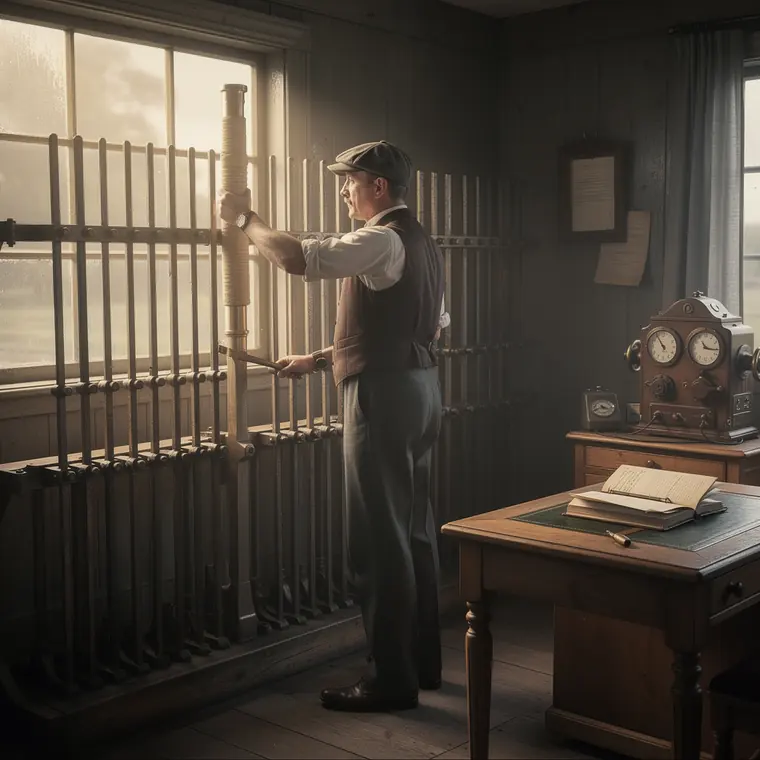
A signalman pulling a lever in a timber signal box: a long frame of tall upright iron levers standing in a row from the floor, each taller than waist height, the signalman gripping one lever near its top with a cloth in his hand on the polished steel, block instruments and a train register open on the desk, the man in waistcoat, collarless shirt with sleeves rolled, dark trousers and a cap.
- What it was used for
- In the signal box the signalman worked an interlocked lever frame: points and signals through wire runs and rodding, plus the block instruments for talking to the boxes on either side. The principle of absolute block is that only one train is in any one block section at a time, the section running from one box's last stop signal to the next box's first (signalbox.org). Historic England states the operating purpose: the box let one man, or at most two, do work that had previously needed several pointsmen and flagmen at ground level. For scale, London Bridge North, opened 1878, had two interlocked frames of 140 levers each, 280 in all. On hours, the Commons on 23 January 1891 heard of a Great Western signalman who followed ten hours on duty with ten more as fog signaller.
- What was new
- What was new was not the signal box but its compulsion. The Regulation of Railways Act 1889 - royal assent 30 August 1889, that date, not the date of passing - empowered the Board of Trade to order companies to adopt the block system, to interlock points and signals, and to use on passenger trains continuous brakes that apply themselves if the continuity of the brake fails (legislation.gov.uk, section 1). Historic England dates the gradual introduction of the block system to the 1860s to 1880s. The occasion was not progress: on 12 June 1889 near Armagh a crowded Methodist Sunday school excursion train was divided on a gradient and the rear portion ran back. The death toll is disputed, because injured passengers died later: the National Railway Museum gives 80 dead and 260 injured, RTÉ Archives 88 dead, and the Armagh Methodist Circuit 89 dead, its list of names showing 19 under fifteen and eleven without an age.
Further reading
- Regulation of Railways Act 1889 (52 & 53 Vict. c. 57) - legislation.gov.uk (königliche Zustimmung 30. August 1889, Abschnitt 1)
- Signal Boxes - Introductions to Heritage Assets, Historic England
- The Basic Principles - The Signal Box (signalbox.org), zum absoluten Block
- London Bridge signal box - Westinghouse Brake & Saxby Signal Co. frame archive (1878: 2 x 140 Hebel)
- Death, Danger and Disaster on the Early Railway - National Railway Museum (80 Tote, 260 Verletzte)
- Armagh Methodist Circuit: Railway Disaster 1889 (89 Tote; Namensliste mit Altersangaben)
- Armagh rail disaster - RTÉ Archives (88 Tote)
- Railway Servants (Hours of Labour), Hansard, House of Commons, 23. Januar 1891