The Platelayers
1880 · Permanent Way Work · Work 377 of 1,871
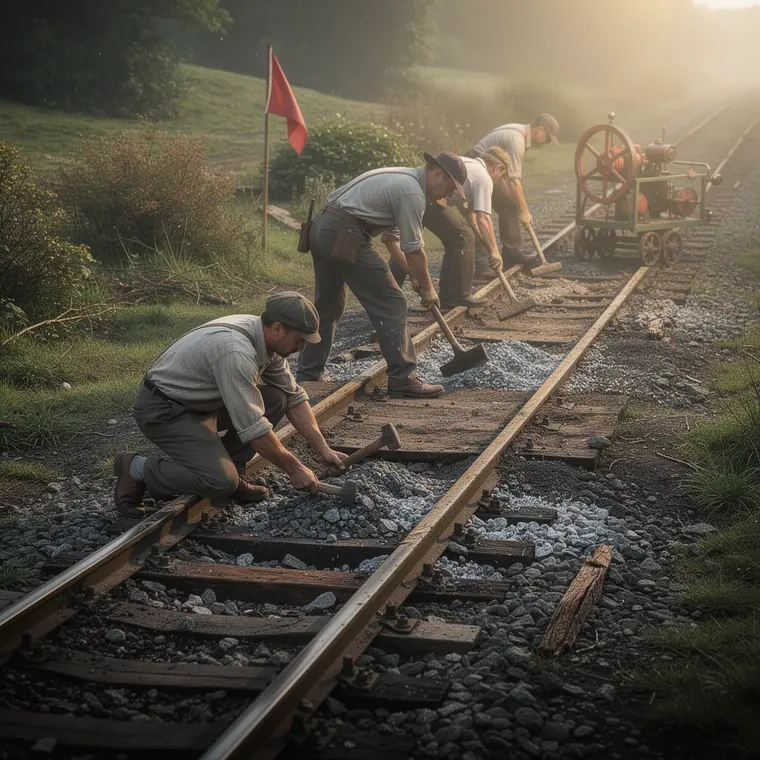
A platelayer gang packing ballast under a sleeper with beaters, one man sighting along the rail from a crouch, their trolley and flag standing further down the track.
- What it was used for
- Gangs under a ganger each maintained an assigned stretch of line: walking and inspecting it, changing rails and sleepers, packing ballast under the rails, correcting gauge, level and superelevation, keeping culverts, ditches and fences clear. Railway Wonders of the World gives the yardstick of inspection: every mile of track over which passenger trains run must be walked daily. The huts for tools and meal breaks stood typically every two or three miles (Friends of the Settle-Carlisle Line), and a lengthman was allocated a couple of miles of track with a hut at the lineside (Box People and Places). The work went on with traffic running, with a lookout: only after the companies amended their rules in February 1913 was no man to act as lookout until passed for it by the engineers' department (Mr Robertson, Board of Trade, Commons, 13 February 1914).
- What was new
- What was new was the form of organisation, not a device: the line divided into fixed lengths, each permanently assigned to a gang and walked daily - maintenance as continuous inspection rather than repair after failure. Which company began this first is not documented; the sources describe it as general practice. The barb is in the name: platelayer comes from the plates of the plateways, and although that technique gave way to the flanged wheel around 1830, the word stayed in use (Wye Valley Greenway). So in 1880 the track workers still bore the name of a technology superseded around 1830. The price shows in the official figures: in the Commons in 1914 Mr Robertson gave, for accidents to platelayers in the last three years, 102 killed and 150 injured, 67 and 96, and 70 and 91, without naming the individual years. An official figure for 1880 broken down by grade is not documented.
Further reading
- Mine and Railway Accidents, Hansard, House of Commons, 13. Februar 1914 (Mr Robertson: Unfallzahlen für Platelayers der letzten drei Jahre; Lookout-Regel der Gesellschaften vom Februar 1913)
- Platelayers - Wye Valley Greenway (Herkunft des Namens aus den plateways)
- The Permanent Way - Railway Wonders of the World (jede Meile täglich abgegangen)
- SCRCA Location Type: Platelayers' Hut - Friends of the Settle-Carlisle Line (Hütten alle zwei bis drei Meilen)
- Railway Gangers - Box People and Places